D7111 is the CDT code for removing the leftover crown of a primary tooth whose roots have already resorbed.
- When to use: The radiograph shows the primary tooth's roots fully resorbed, but the crown has not come out on its own and needs instruments to remove.
- When not to use: A primary tooth that still has roots is D7140, and residual roots of a permanent tooth that need cutting are D7250.
- Billing note: Carriers reclassify to D7140 when the claim lacks proof of absent roots, so attach a radiograph and a note saying only the crown remained.
What D7111 covers
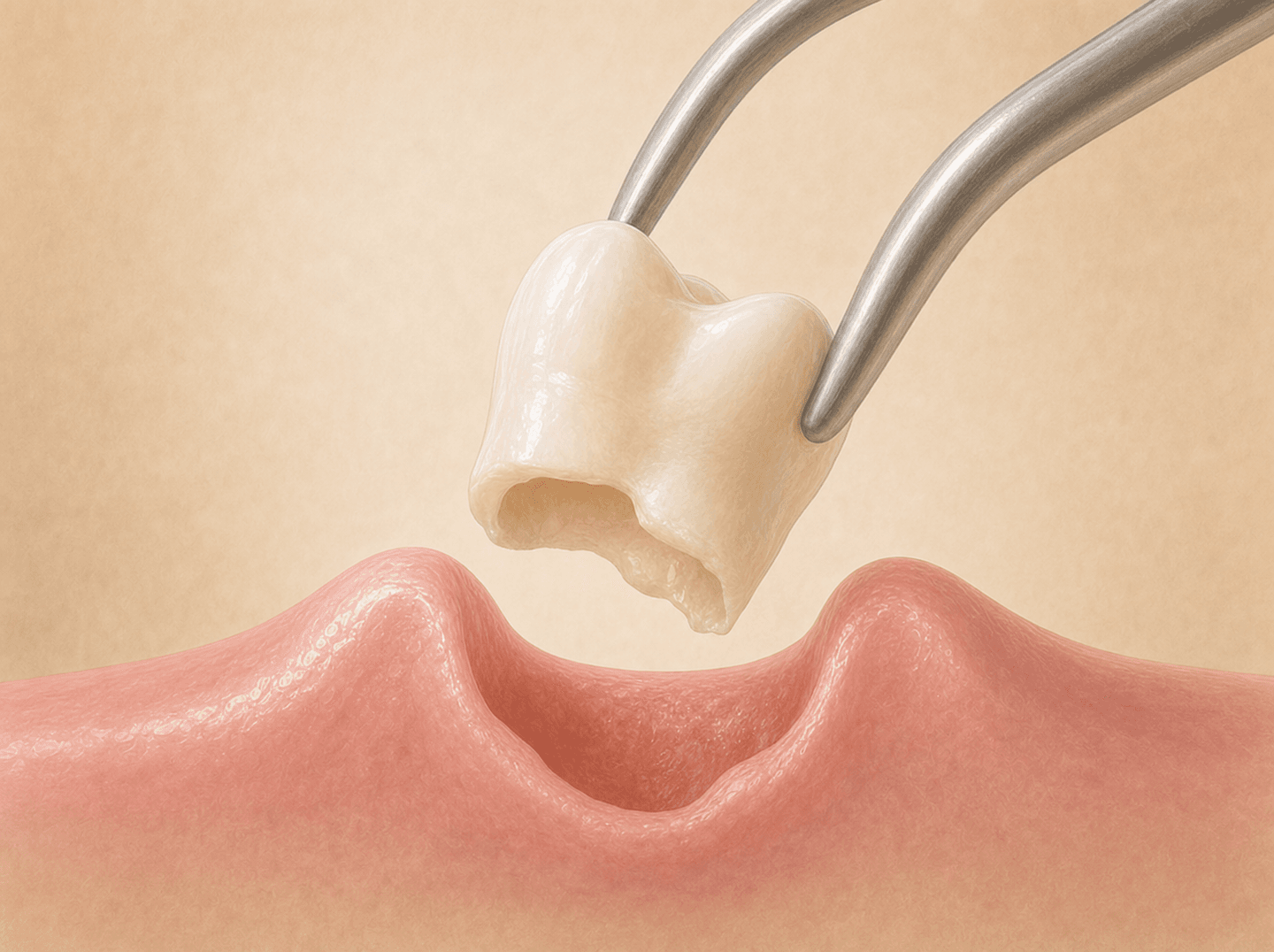
D7111 reports removing what is left of a primary (baby) tooth after its roots are gone. The roots have resorbed during normal exfoliation or are otherwise absent, and the crown, or a remnant of it, is the only structure left. The code applies when the crown has not come out on its own, often because decay broke it down or exfoliation stalled, and instrumentation is needed to remove it.
It does not cover:
- A primary tooth that still has roots. Removing a rooted primary tooth by elevation or forceps is D7140.
- A permanent tooth in any form. Use the appropriate permanent-tooth extraction code.
- Residual roots of a permanent tooth that require cutting to remove. That is D7250.
- A surgical extraction requiring a flap, bone removal, or sectioning. Those are D7210 and the impaction codes.
D7111 versus D7140
Both codes apply to baby teeth, and the line between them is the most common source of error on D7111. The distinction is root structure:
- D7111 is the coronal remnant. No roots remain, and the procedure removes the leftover crown.
- D7140 is the extraction of a primary tooth that still has roots, delivered by elevation, forceps, or both. It applies even if the crown is mostly destroyed.
A carrier reviewing D7111 checks whether there was really no root, or whether this was a routine primary extraction. If the film shows resorbed or absent roots and the note says only coronal structure was present, D7111 holds.
Top reasons D7111 gets denied or downgraded
- Reclassified to D7140. The carrier reads the case as an ordinary primary extraction and pays the D7140 allowable. The defense is documentation that root structure was absent.
- Questioned as not separately billable. Some plans do not treat removal of a loose, near-exfoliating remnant as a distinct procedure. This is plan language; a note describing the instrumentation required helps.
- Missing documentation. Without a radiograph and a description of what remained, the carrier cannot confirm the code.
- Tooth number outside the primary range. A permanent tooth number on a D7111 line is denied automatically.
Documentation that supports the claim
Attach to the claim:
- A radiograph showing absent or fully resorbed roots.
- A note stating that only coronal structure remained.
- A short description of how the remnant was removed.
In the patient record, written at treatment time, document:
- The tooth number and that it is primary.
- The condition of the crown (decay, fracture, retained after partial exfoliation).
- The absence of root structure.
- The instrument or technique used.
The key sentence names the absence of roots, for example: “Tooth K presented as a retained coronal remnant with no remaining root structure on the radiograph; the crown was elevated and removed.”
Example case
A 7-year-old established patient has tooth A, a primary second molar, with a grossly decayed crown that has not exfoliated. The radiograph shows the roots have fully resorbed and only the coronal structure remains. The dentist removes the remnant.
- Take a pre-op radiograph showing the absence of roots.
- Code D7111 with the tooth number and a note describing the coronal-only remnant.
- Attach the film to the claim.
- If the carrier downgrades to D7140, appeal with the radiograph and the note documenting absent root structure.
FAQs
- What's the difference between D7111 and D7140 on a baby tooth?
- Whether root structure remained. D7111 is for a primary tooth where only the crown remains and the roots have resorbed or are gone. D7140 is for a primary tooth that still has roots, removed by elevation or forceps.
- Does D7111 only apply to primary teeth?
- Yes. D7111 is a pediatric code for primary (baby) teeth only. A permanent tooth is coded differently; residual roots of a permanent tooth that require cutting to remove are D7250.
- Why did the carrier deny or downgrade my D7111 claim?
- Usually because the carrier read it as a routine primary extraction and reclassified it to D7140, or because the plan questions whether removing a near-exfoliating remnant is separately billable. The defense is a note stating that only coronal structure remained, with no root present, and that instrumentation was needed. Outcomes are plan-dependent.
- Do I need an X-ray for D7111?
- Most carriers want one, and it helps the claim either way. A radiograph showing absent root structure supports D7111 over D7140. Attach it to the initial claim rather than waiting for a request. Plan requirements vary.
- Can D7111 be billed per tooth on the same date?
- Yes. D7111 reports one tooth, so each remnant gets its own line and tooth number. There is no code-level limit per visit, though some plans cap the number of extractions paid per day. That is a benefit cap, not a coding restriction.
Related codes
Need help billing this code?
We handle D7111 claims daily.
If your team is spending time on denials, narratives, or carrier follow-up for this code, our outsourced dental insurance billing service can take it off your plate. We submit the claims, post what comes back, and follow up on anything unpaid. Already sitting on older claims that never paid? Our AR cleanup project works the backlog.
“Claims, posting, denials, all of it gets handled, and it costs far less than hiring another employee. My front desk got hours of their week back, and honestly I just don't think about billing anymore.”
CDT codes are maintained by the American Dental Association. This page is an editorial billing guide, not the official ADA code descriptor. Verify current coverage policies with each carrier before submitting claims.