D9110 is the CDT code for minor, hands-on care that relieves a patient's dental pain without curing the underlying problem, reported once for the visit when the relief work has no code of its own.
It's the emergency-relief code: the patient walks in hurting, you do something to calm the tooth down, and they come back later for the real fix. The catch that drives most denials is in the definition itself. D9110 covers relief work that has no distinct code of its own, and it generally can't ride on the same claim as a definitive procedure on that tooth. The other recurring mix-up is treating D9110 as the emergency visit's exam code, when that's actually D0140.
On this page
- What D9110 covers
- What D9110 is not
- The distinguishing axis: relief without definitive treatment
- Why D9110 bundles into definitive treatment
- D9110 with D0140 on an emergency visit
- The x-ray that rides along
- Documentation that supports the claim
- When repeated D9110 claims draw scrutiny
- What to get right in your PMS
- FAQs
What D9110 covers
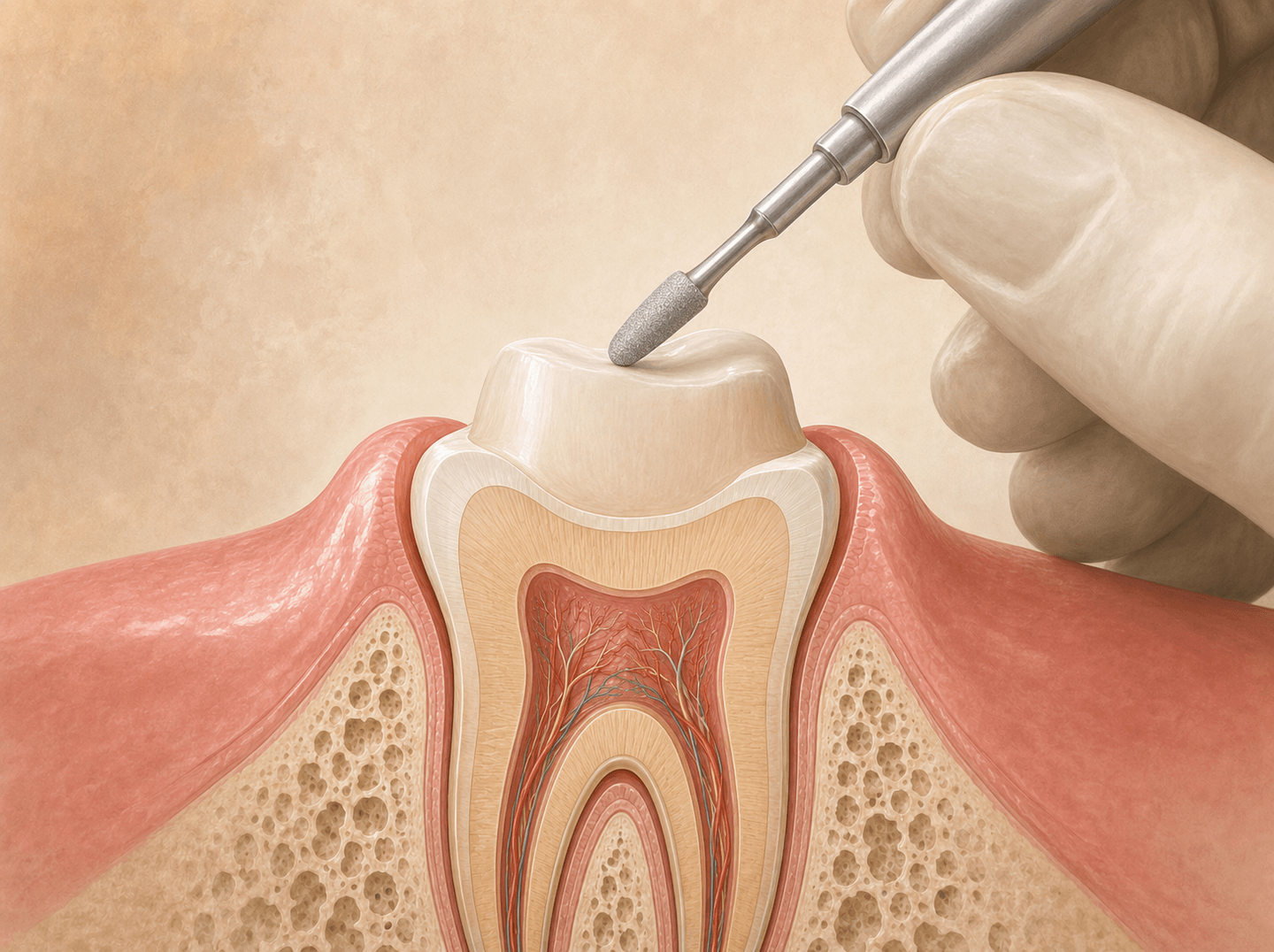
D9110 reports palliative care for dental pain, once for the visit: hands-on care that relieves a patient’s pain or discomfort without resolving the underlying condition. It’s the emergency-relief code for the situation every practice sees, the patient who calls hurting and gets seen the same day for something temporary while the definitive treatment waits for a planned appointment.
The defining feature is in the code’s own scope. D9110 covers relief procedures that do not have a distinct CDT code of their own. If the work you did to calm the tooth down already has its own code, you bill that code, not D9110.
Common situations that fit D9110:
- Smoothing the sharp edge of a fractured tooth or broken restoration so it stops cutting the tongue or cheek.
- Placing a sedative dressing or intermediate restorative material (IRM) in an open or symptomatic tooth, pending a permanent restoration.
- Adjusting a tooth out of occlusion to relieve pain from a high spot or acute pressure.
- Removing food impaction that’s driving gingival inflammation and pain.
- Administering local anesthetic purely to give temporary relief at the visit.
What D9110 is not
- The emergency exam. Looking at the patient and diagnosing the complaint is a limited, problem-focused evaluation: D0140. D9110 is the treatment, not the assessment. This is the single most common mix-up on the code.
- A definitive procedure. An extraction, a filling, a pulpotomy, the start of a root canal: those are curative and each has its own code. When you do one of those, that’s what you bill.
- A catch-all for any emergency action. Some emergency relief work has its own dedicated code. Sectioning a bridge to relieve a problem is D9120, not D9110. If a distinct code exists for what you did, use it.
- A pain-management add-on to other treatment. D9110 is the procedure when relief is the procedure. It’s not a modifier you append to a visit where definitive work was already done.
The distinguishing axis: relief without definitive treatment
This is where D9110 gets miscoded, so it’s worth stating plainly. D9110 belongs on a claim only when two things are true: the work relieved pain without curing the cause, and that relief work has no distinct code of its own.
That’s the line. It separates D9110 from two neighbors at once.
It separates D9110 from D0140, the limited oral evaluation, because one is the exam and the other is the treatment. The dentist who sees an emergency patient often does both: a problem-focused look (D0140) and a temporary fix (D9110). Both can be reported because they’re genuinely different procedures.
It separates D9110 from definitive treatment, because the moment you extract, restore, or open the tooth for endodontics, you’ve done a curative procedure with its own code. D9110 was built for the visit where you didn’t do that yet.
Why D9110 bundles into definitive treatment
The most predictable D9110 denial is the same-day bundle. When a definitive procedure is performed on the tooth at the same visit, most carriers consider the palliative element included in that procedure and won’t pay D9110 separately. This isn’t a carrier being difficult. It follows from what the code reports. D9110 covers relief that stands alone, and once you’ve done the curative work, the relief is part of it.
The practical consequence: the clean D9110 claim is the visit where you stabilized the tooth and scheduled the real treatment for another day. Patient comes in Friday with a fractured cusp and pain, you smooth the edge and place a sedative filling (D9110), and the crown prep goes on the books for next week. That sequence is exactly what the code was written for.
D9110 with D0140 on an emergency visit
The emergency visit that supports both codes is the common one. A patient presents in pain. The dentist performs a problem-focused evaluation to diagnose the source (D0140), then does something to relieve the pain (D9110). Two procedures, two codes, one date of service.
Whether both get paid is plan-dependent. Some plans reimburse the evaluation and the palliative treatment together. Some pay the exam and bundle the relief. Some do the reverse. The reporting is correct either way. The reimbursement is a coverage question, not a coding question.
One useful distinction for the front desk: D0140 counts against the plan’s evaluation frequency limits, the way other exam codes do. D9110 does not carry an evaluation frequency cap, because emergencies don’t follow a schedule. That doesn’t make D9110 a workaround for a patient who’s used up their exams. The codes report different work and should be billed for what was actually done. But it does mean an emergency relief visit isn’t blocked by the patient’s exam history.
The x-ray that rides along
A radiograph taken to diagnose the emergency is a separate, billable procedure, and it’s the standard companion to a palliative visit. The imaging reports the film. D9110 reports the relief work.
- D0220 is the first periapical image at the visit.
- D0230 is each additional periapical image after the first.
- D0210 is a comprehensive full-mouth series, when that’s what was taken (and you don’t separately bill D0220/D0230 on the same date when you’ve billed the full series).
Document why the film was taken. An emergency claim with a pain complaint, a diagnostic x-ray, and a palliative treatment reads as a coherent visit. The same claim with the x-ray and no stated reason reads as a routine image tacked on.
Documentation that supports the claim
Even though the procedure is simple, the chart note is what separates a paid D9110 from a denied one. The note should capture:
- The complaint. Why the patient came in, in their words and the clinical finding. “Patient presents with sharp pain on the lower left, fractured distolingual cusp #19” is the line that establishes the emergency.
- The relief performed. What you actually did to relieve the pain: smoothed the fractured edge, placed IRM, adjusted occlusion, removed impaction. Name it.
- That it was palliative, not definitive. State that the treatment was temporary and that definitive care is planned. “Sedative filling placed, patient to return for crown prep” tells the reviewer this was relief, not the cure.
- The reason any same-visit procedure was separate. If you also billed D0140 and an x-ray, the note should make each one’s purpose clear so the claim doesn’t look like one procedure split into three lines.
For the claim itself, a one-line narrative helps on plans that pend palliative claims for review: “Emergency visit, palliative treatment of acute pain on #19, definitive crown planned.” One sentence that names the complaint and the deferred definitive treatment is usually enough.
When repeated D9110 claims draw scrutiny
D9110 has no built-in frequency limit, but that’s not a blank check. Carrier behavior is plan-dependent: some run utilization edits, and repeated palliative visits on the same patient, or the same tooth, with no documented move toward definitive treatment, can trigger review.
The defensible pattern is one emergency, one documented complaint, one relief procedure, with a treatment plan that points at the eventual fix. A patient who keeps coming back for palliative care on the same tooth without ever getting the definitive treatment is the pattern a reviewer questions. If there’s a clinical reason the definitive work keeps getting deferred, document it.
What to get right in your PMS
The exact menus differ across Open Dental, Dentrix, Eaglesoft, Curve, and Carestream, but the setup that prevents D9110 problems is the same:
- Keep D9110 (palliative treatment) and D0140 (limited exam) as distinct, clearly labeled entries. The fastest way to miscode an emergency visit is to have one fuzzy “emergency” button. Make the exam and the treatment separate line items so the front desk picks the ones that match what actually happened.
- Flag the same-day-definitive bundle in your workflow. If a definitive procedure (extraction, restoration, endo) is posted on the same tooth and date as D9110, that should prompt a check before the claim goes out, because the palliative line will usually bundle.
- Capture the complaint and the deferred-treatment plan in the note at point of care. That single detail is what defends D9110 if the claim is reviewed.
- Attach the narrative to the claim, not just the patient record. Many systems store narratives at the patient level by default, and the clearinghouse needs it linked to the specific emergency claim.
FAQs
- What is the dental code for emergency pain treatment?
- For palliative pain relief, it's D9110, reported once for the visit. It covers temporary relief work that doesn't have its own CDT code: smoothing a sharp fractured edge, placing a sedative or intermediate restorative material in an open tooth, adjusting a tooth out of occlusion, or removing food impaction causing gum pain. If the patient also needs a problem-focused exam, that's a separate code, D0140. D9110 is the treatment you did, not the evaluation.
- What's the difference between D9110 and D0140?
- D0140 is the limited, problem-focused oral evaluation: the dentist examining a specific complaint and figuring out what's wrong. D9110 is the palliative treatment that relieves the pain. One reports what you assessed, the other reports what you did. They can appear on the same emergency-visit claim because they're different procedures, but reimbursement is plan-dependent. Some plans pay both, some pay one and bundle the other. D0140 also counts against evaluation frequency limits. D9110 has no frequency cap.
- Can I bill D9110 with a filling or extraction on the same tooth?
- Usually no. D9110 is for relief when no definitive procedure is performed, and it covers work that has no distinct code of its own. If you extract the tooth, restore it, or start a root canal at that visit, that definitive procedure has its own code and is what you bill. Stacking D9110 on top reads as unbundling and tends to deny. The clean D9110 scenario is the temporary fix today, definitive treatment at a later visit.
- Does D9110 have a frequency limit?
- D9110 has no inherent per-period frequency cap the way evaluation codes do, because emergencies aren't scheduled. That said, plan-dependent: a carrier can still review repeated D9110 claims on the same patient or tooth for medical necessity, and some plans apply their own utilization edits. Each emergency visit should stand on its own documented complaint and relief work. Repeated palliative visits on one tooth with no move toward definitive treatment will draw scrutiny.
- Can I bill an x-ray with D9110?
- Yes. A radiograph taken to diagnose the emergency is a separate, billable procedure and is the typical companion to a palliative visit: D0220 for the first periapical image and D0230 for each additional one, or D0210 for a full-mouth series. The x-ray reports the imaging. D9110 reports the relief work. Document the clinical reason for the film so the emergency claim hangs together.
- Why did the carrier deny D9110?
- Plan-dependent, but the usual reasons are: a definitive procedure was billed on the same tooth the same day (D9110 bundles into it), the claim had no documented pain complaint or relief work, the plan pays the exam (D0140) and bundles the palliative treatment, or the plan simply excludes palliative care as a separate benefit. Read the EOB before appealing. A same-day-definitive bundle isn't an error to appeal. A missing-documentation denial is fixable with a narrative and resubmission.
Related codes
Need help billing this code?
We handle D9110 claims daily.
If your team is spending time on denials, narratives, or carrier follow-up for this code, our outsourced dental insurance billing service can take it off your plate. We work inside your PMS and post payments the same week.
CDT codes are maintained by the American Dental Association. This page is an editorial billing guide, not the official ADA code descriptor. Verify current coverage policies with each carrier before submitting claims.