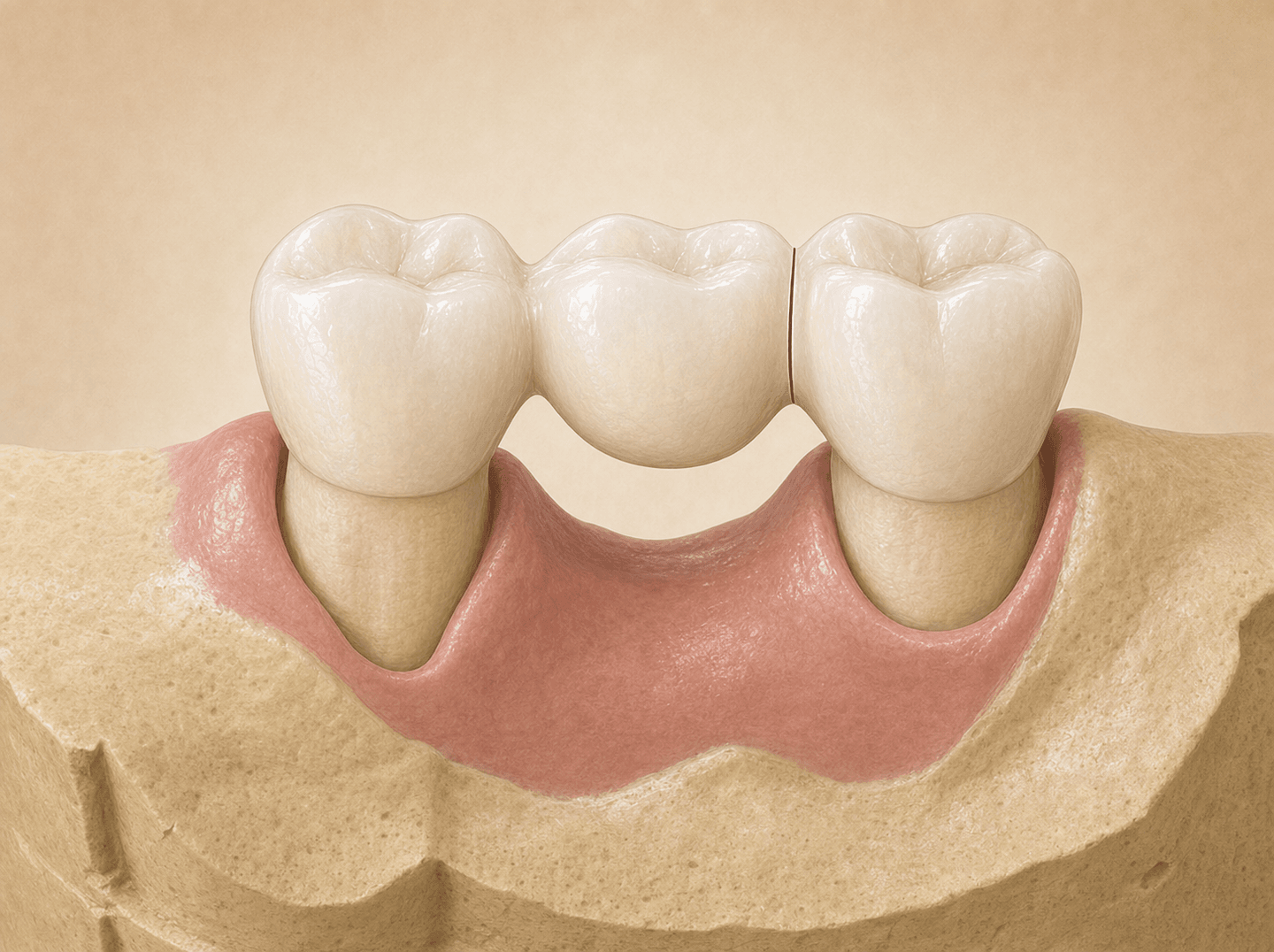
D9120 is the CDT code for sectioning a fixed partial denture — cutting through the connector between abutments and pontics so a failing portion of a bridge can come out while the serviceable part stays in place.
The defining detail is that something is meant to remain. You separate the prosthesis at a joint, remove the compromised unit, and leave the serviceable portion in place. That fact drives every coding decision around it. D9120 is not an extraction, even though one often follows it. It is not re-cementing a loose-but-intact bridge. And on many plans it does not pay separately when the whole bridge is coming out anyway.
On this page
- What D9120 covers
- What D9120 is not
- The distinction that drives the code: cutting the prosthesis vs. cutting the tooth
- When to bill D9120
- The bundling rule: when D9120 will not pay separately
- Documentation that supports the claim
- D9120 versus the codes it gets confused with
- How D9120 and D9110 relate
- What to get right in your PMS
- FAQs
What D9120 covers
D9120 reports the sectioning of a fixed partial denture: separating one or more of the connections between the bridge’s abutments and pontics so a compromised portion can be removed while the rest of the prosthesis stays in place and keeps working. The procedure is the cut itself, the controlled separation of the bridge at a connector, usually with a high-speed handpiece and a diamond or carbide bur.
D9120 applies when part of the bridge is meant to remain intact and serviceable after the cut. You are not taking the whole prosthesis out. You are dividing it so the failing unit can go and the sound unit can stay.
It belongs to the adjunctive general services family, in the palliative and emergency-treatment range, because it is often done to resolve an acute problem under a bridge without committing the patient to immediate full replacement.
What D9120 is not
- An extraction. Cutting the bridge is not removing a tooth. If an abutment tooth under the sectioned portion has to come out, that extraction is separate: D7140 for a routine forceps extraction, D7210 when bone removal or tooth sectioning is involved. D9120 covers the cut through the prosthesis, not the surgery on the tooth.
- Re-cementing a loose bridge. A fixed partial denture that came loose but is otherwise intact gets re-cemented under D6930, not sectioned. D9120 is destructive (you cut the prosthesis); D6930 is restorative (you re-seat an intact one).
- A bridge repair. Fixing a fractured pontic or a chipped retainer where the material failed is D6980 (fixed partial denture repair necessitated by restorative material failure). That restores the prosthesis. D9120 divides it.
- Sectioning splinted crowns. Crowns splinted together with no pontic between them are not a fixed partial denture. Several carriers explicitly state D9120 does not cover separating splinted crowns. The presence of a pontic is what makes it an FPD.
The distinction that drives the code: cutting the prosthesis vs. cutting the tooth
This is where D9120 gets miscoded, so be exact. The word “sectioning” shows up in two unrelated places in the code book, and they describe two different objects being cut.
D9120 is sectioning the prosthesis. You cut through the metal connector of the bridge to separate units.
D7210 is a surgical extraction that may involve sectioning the tooth. There, you cut the tooth itself to remove it from the bone. The bridge is not the object.
These are not interchangeable, and they frequently happen in the same appointment, which is exactly why they get blurred. A common sequence: section the bridge (D9120) to free a failing abutment, then surgically remove that abutment tooth, sectioning the tooth as you go (D7210). Two cuts, two objects, two codes. The chart note has to make clear what was cut and why.
When to bill D9120
Bill D9120 when you cut a fixed partial denture at one or more connectors and a portion of it is meant to stay in place and remain serviceable. Common clinical triggers:
- Recurrent decay under one abutment of a multi-unit bridge, where that unit and its tooth have to go but the rest of the bridge is sound.
- A failed or mobile abutment tooth at one end of the bridge, with the other abutment and pontic still well-supported.
- A fractured or non-restorable unit that must be separated out without sacrificing the intact span.
Do not bill D9120 for:
- Removing the entire bridge with no portion preserved (more on the bundling problem below).
- Re-cementing a loose but intact bridge (D6930).
- Repairing fractured prosthesis material (D6980).
- The extraction itself (D7140 or D7210).
The bundling rule: when D9120 will not pay separately
Here is the rule that catches practices off guard. When sectioning is a step in removing and replacing the whole fixed partial denture, many payers consider it integral to the new prosthesis and will not reimburse D9120 as a separate line. On a participating plan, that usually means the fee cannot be balance-billed to the patient either, because it was rolled into the replacement.
D9120 pays as its own service when something is genuinely staying. If the whole bridge is coming out so a new one can go in, the cut is part of that larger procedure in the eyes of most carriers.
Documentation that supports the claim
For plans that benefit D9120, the documentation has two jobs: prove the sectioning was necessary, and prove that a portion remained intact and serviceable. The chart note should capture:
- The clinical reason. Why the bridge had to be sectioned: recurrent caries under a named abutment, a failed or mobile abutment tooth, a non-restorable unit. Tie it to a tooth number.
- Where you cut. Which connector was sectioned, between which units. “Sectioned at the connector between the pontic at #19 and the retainer at #18.”
- What remained. State explicitly that the remaining portion is intact and serviceable, because that is the benefit trigger on most plans. If nothing remained, that points toward the bundling rule above.
- The pre-op image. A radiograph showing the entire fixed partial denture before sectioning. Carriers like Northeast Delta Dental ask for a pre-op image of the whole bridge plus notes in the legal record.
If an extraction followed, document it separately with its own code and its own narrative so the prosthesis cut and the tooth removal don’t read as one blurred event.
D9120 versus the codes it gets confused with
These codes cluster around a failing bridge, but each reports a different action.
D9120 (fixed partial denture sectioning) answers: I cut the bridge at a connector to remove part of it and keep the rest. The object cut is the prosthesis. A portion stays.
D6930 (re-cement or re-bond fixed partial denture) answers: the bridge came loose but is intact, and I re-seated it. Nothing was cut, nothing removed.
D2920 (re-cement or re-bond crown) answers: a single crown came loose and I re-seated it. The bridge analog is D6930; using D2920 for a bridge retainer is a common miscode.
D6980 (fixed partial denture repair necessitated by restorative material failure) answers: a unit of the bridge fractured and I repaired the material. The prosthesis is restored, not divided.
D7140 / D7210 (extractions) answer: I removed a tooth. D7210’s “sectioning” is sectioning the tooth, not the bridge. These pair with D9120 in the same visit but report a different object.
The billing mistake to avoid: billing D9120 for the extraction, billing D6930 when you actually sectioned, or letting a same-visit extraction absorb the sectioning note so the two can’t be told apart.
How D9120 and D9110 relate
D9110 (palliative pain relief) and D9120 both live in the adjunctive general services range and both can come up when a patient presents in distress under a bridge. They are not the same service. D9110 reports emergency relief of pain when no definitive procedure is done that visit. D9120 is a definitive mechanical procedure: you cut the prosthesis. If you sectioned the bridge, that is the service performed, and D9110 generally is not reported on top of it for the same problem. Code the procedure you actually did.
What to get right in your PMS
The menus differ across Open Dental, Dentrix, Eaglesoft, Curve, and Carestream, but the setup that prevents problems is the same:
- Keep D9120 distinct from the re-cement and repair codes. D9120 (section), D6930 (re-cement bridge), D2920 (re-cement crown), and D6980 (repair bridge) are four different actions on a bridge. One fuzzy “bridge” entry is how they get crossed.
- Post the extraction on its own line. When a tooth comes out the same visit, enter D7140 or D7210 separately. Don’t let D9120 stand in for the extraction or vice versa.
- Flag the bundling question on full replacements. If a new bridge or denture is on the treatment plan, set the expectation that D9120 may not pay separately. Verify the plan before quoting.
- Attach the pre-op image and the note to the claim. Many systems store images and narratives at the patient level by default. The carrier needs the pre-op radiograph of the whole bridge and the necessity note linked to the D9120 line.
- Record what remained. A single line confirming the preserved portion is intact and serviceable is what defends the code if the claim is reviewed.
FAQs
- What is the dental code for sectioning a bridge?
- D9120, fixed partial denture sectioning. It reports cutting through one or more of the connections between the abutments and pontics of a bridge so that part of the prosthesis can be removed while the rest stays intact and serviceable. The key word is 'sectioning': you are separating the bridge at a joint, not removing the whole thing and not pulling a tooth. If the entire bridge is coming out, or you are only cementing a loose bridge back on, D9120 is the wrong code.
- Is D9120 the same as extracting the tooth under a bridge?
- No, and this is the most common mix-up. D9120 reports cutting the prosthesis (the bridge metal at a connector), not removing a tooth. Sectioning the bridge frees a failing unit, but the actual extraction of an abutment tooth underneath is a separate procedure billed under D7140 (simple) or D7210 (surgical). Note the trap with D7210: the 'sectioning' in that code refers to sectioning the tooth during a surgical extraction, not sectioning the bridge. Two different things are being cut. Document which one you did.
- Does insurance pay D9120 separately?
- It depends on the plan and on why you sectioned. When a portion of the bridge genuinely remains intact and serviceable after sectioning, many carriers will benefit D9120 with documentation. But when sectioning is just a step in removing and replacing the entire bridge, payers commonly treat it as integral to the new prosthesis and will not pay it separately, and on a participating plan it usually cannot be balance-billed to the patient either. Verify the specific plan's policy before quoting anything.
- What documentation does D9120 need to get paid?
- Carriers that benefit D9120 generally want a pre-operative radiograph showing the entire fixed partial denture and a chart note explaining why sectioning was necessary and what stayed in place. State the clinical reason (recurrent decay under one abutment, a failed or mobile abutment tooth, a fractured unit) and document that the remaining portion is intact and serviceable. Northeast Delta Dental, for example, asks for a pre-op image of the whole bridge and notes in the legal record. Specifics on which tooth and which connector help.
- Can I bill D9120 for cutting apart splinted crowns?
- Not under most carrier guidance. D9120 is written for a fixed partial denture, which by definition includes one or more pontics (the replacement tooth spanning a gap). Splinted crowns joined together with no pontic are not a fixed partial denture, so several carriers, including Northeast Delta Dental, state D9120 does not cover separating splinted crowns. Check the specific plan, but do not assume D9120 applies just because two restorations are joined and you cut them apart.
Related codes
Need help billing this code?
We handle D9120 claims daily.
If your team is spending time on denials, narratives, or carrier follow-up for this code, our outsourced dental insurance billing service can take it off your plate. We work inside your PMS and post payments the same week.
CDT codes are maintained by the American Dental Association. This page is an editorial billing guide, not the official ADA code descriptor. Verify current coverage policies with each carrier before submitting claims.