D6545 is the CDT code for a cast metal wing bonded to an abutment tooth to retain a resin-bonded bridge, often called a Maryland bridge.
- When to use: A Maryland bridge uses cast metal wings bonded to the abutment teeth, so each wing gets its own D6545 line by tooth.
- When not to use: Porcelain or ceramic wings are D6548, resin wings are D6549, and a full crown on the abutment takes a retainer crown code such as D6750.
- Billing note: The pontic is never inside D6545, so add a separate pontic line coded to the pontic's own material.
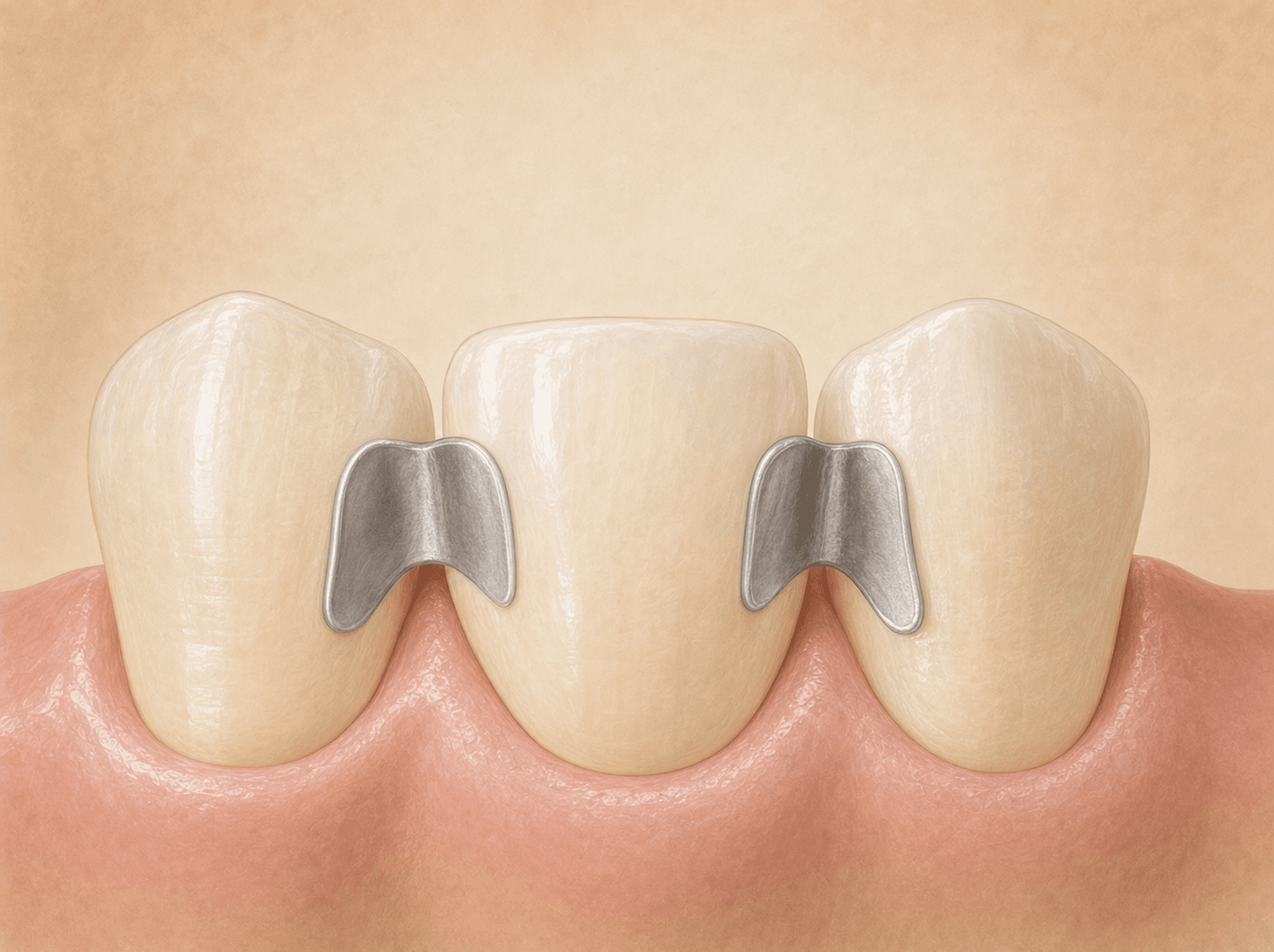
What a Maryland bridge is, in coding terms
A Maryland bridge is a resin-bonded fixed bridge. Instead of crowning the teeth next to the gap, the lab makes a pontic with thin wings that are etched and bonded to the tongue side of the neighboring teeth, mostly on enamel. The abutment teeth keep nearly all of their structure.
CDT treats the wings as retainers, the same role a crown plays in a conventional bridge, and gives them their own codes by material:
- D6545: cast metal wing.
- D6548: porcelain or ceramic wing.
- D6549: resin wing.
“Maryland bridge” is a trade name, not a CDT term. When a provider charts “Maryland” and nothing else, the biller still needs to know the wing material before choosing a code.
How to build the claim
A resin-bonded bridge bills as separate lines, just like a crowned bridge:
- One retainer line per wing, with the tooth number of the abutment tooth that wing is bonded to.
- One pontic line per replaced tooth, with the missing tooth’s number, coded by the pontic’s material.
The pontic code is independent of the wing code. Cast metal wings commonly carry a porcelain-fused-to-metal pontic, and the PFM pontic code follows that pontic’s alloy: D6240 high noble, D6241 base, D6242 noble. But labs also make all-ceramic (D6245), indirect composite (D6205), resin-over-metal (D6250 to D6252) and full cast (D6210 to D6212) pontics. Code the pontic the lab made.
Worked example: a congenitally missing lateral incisor
A 24-year-old patient is congenitally missing #7. The canine and central incisor next to the space are unrestored with healthy enamel. The dentist prescribes a Maryland bridge with cast metal wings bonded to the lingual of #6 and #8 and a porcelain-fused-to-noble-metal pontic.
The claim on the bonding date:
| Line | Tooth | Code | What it reports |
|---|---|---|---|
| 1 | 6 | D6545 | Cast metal wing on the canine |
| 2 | 7 | D6242 | PFM pontic, noble alloy |
| 3 | 8 | D6545 | Cast metal wing on the central incisor |
Two things to check before sending it. First, the missing-tooth clause. A congenitally missing tooth was never lost during coverage, and how a plan treats that depends on its wording. Second, whether the plan has any age or prior-treatment conditions on fixed bridges. Both belong in the pre-treatment estimate.
Retainer crowns are a different procedure
The common miscode on resin-bonded bridges is reaching for a crown retainer code like D6750 (PFM, high noble) or D6740 (all ceramic) because the bridge was entered in the PMS as a “3-unit bridge.” Those codes describe a full crown on a prepared tooth. A wing bonded to the lingual enamel is not a crown, and a claim that reports one can pend for records or be reprocessed once the radiograph shows unprepared abutments.
The reverse also happens. A hybrid design with a full crown on one side and a bonded wing on the other gets a crown retainer code for the crowned tooth and D6545 for the wing.
When carriers look harder at D6545
Resin-bonded bridges suit a narrow set of cases, and payer clinical policies say so. UnitedHealthcare’s fixed prosthodontics policy (DCP017.14, effective November 1, 2026) lists resin-bonded appliances as indicated to replace one missing tooth where the abutments are unrestored and undamaged. It lists compromised enamel, deep vertical overlap, heavy occlusion, and parafunctional habits such as bruxism as reasons they are not indicated.
Some carriers also want films up front. Delta Dental of Minnesota’s 2026 prepayment review list requires a radiograph with D6545 and D6548. A pre-operative periapical showing both abutments and the space answers most of these reviews, and a short narrative noting the abutments are unrestored helps when the plan’s criteria mention it.
When the bridge comes off
Debonding is the typical failure. When the same bridge is cleaned and bonded back, report D6930, re-cement or re-bond of a fixed partial denture. Plans that cover it often limit how soon after placement, or how often, they will pay, and some treat a rebond by the placing office within a set window as part of the original fee. A remake is a new bridge, with new wing and pontic lines, and it is subject to the replacement frequency limit.
FAQs
- What is the dental code for a Maryland bridge?
- A Maryland bridge has no single code. It is billed as its parts: a retainer code for each bonded wing and a pontic code for the replacement tooth. Cast metal wings are D6545, porcelain or ceramic wings are D6548, and resin wings are D6549. The pontic is coded by what it is made of.
- Is D6545 billed per wing or per bridge?
- Per wing. Each wing is bonded to one abutment tooth, so a conventional two-wing Maryland bridge is two D6545 lines, each with that abutment's tooth number, plus one pontic line. Some fee schedules phrase the unit as per tooth, which comes to the same count. A single-wing cantilever design is one D6545 line plus the pontic.
- Which pontic code goes with D6545 wings?
- Whichever code matches the pontic the lab made, since wing and pontic codes are chosen independently. A porcelain-fused-to-metal pontic on a cast metal wing bridge is D6240, D6241, or D6242 depending on the pontic alloy, even though the D6545 wings themselves have no alloy split.
- What code do I use when a Maryland bridge debonds?
- D6930, the re-cement or re-bond code for a fixed partial denture, when the same bridge is bonded back in place. Do not rebill D6545 for a rebond. If the bridge is remade, the new wings and pontic are billed as a new bridge and meet the plan's replacement frequency rules.
- Is a Maryland bridge covered like a regular bridge?
- On many plans it is treated as a fixed bridge, so the missing-tooth clause, waiting periods, and replacement frequency limits still apply. Coverage varies by plan, and some plans pay a different benefit for a resin-bonded design. Run a pre-treatment estimate with the wing and pontic codes listed separately.
Related codes
Need help billing this code?
We handle D6545 claims daily.
If your team is spending time on denials, narratives, or carrier follow-up for this code, our outsourced dental insurance billing service can take it off your plate. We submit the claims, post what comes back, and follow up on anything unpaid. Already sitting on older claims that never paid? Our AR cleanup project works the backlog.
“Claims, posting, denials, all of it gets handled, and it costs far less than hiring another employee. My front desk got hours of their week back, and honestly I just don't think about billing anymore.”
CDT codes are maintained by the American Dental Association. This page is an editorial billing guide, not the official ADA code descriptor. Verify current coverage policies with each carrier before submitting claims.