On this page
The CDT code for a bone graft depends on where the graft went and what else happened at that site on the same day. A socket, an implant site, a periodontal defect around a tooth that is staying, a healed ridge, and a sinus floor each have their own code. This guide covers how to pick the code and the billing rules that apply to every graft code. Each code page has the details that only apply to that code.
Five questions, in order
Ask these in sequence and stop at the first yes. The order matters, because some sites answer yes to more than one question.
- Is the graft raising the floor of the maxillary sinus? That is a sinus augmentation. The approach picks the code: D7951 when the surgeon opens a window in the side wall of the maxilla, D7952 when the lift comes up through the crest of the ridge.
- Is a natural tooth staying at the site? A graft into a periodontal defect around a retained tooth is D4263 for the first site in the quadrant and D4264 for each additional site. A graft placed during apical surgery, such as an apicoectomy, is D3428 per tooth, with D3429 for each additional contiguous tooth in the same surgical site.
- Is there an implant at the site? If the implant goes in at this visit, the graft is D6104. If the implant was placed earlier and now has a bony defect around it, the graft is D6103.
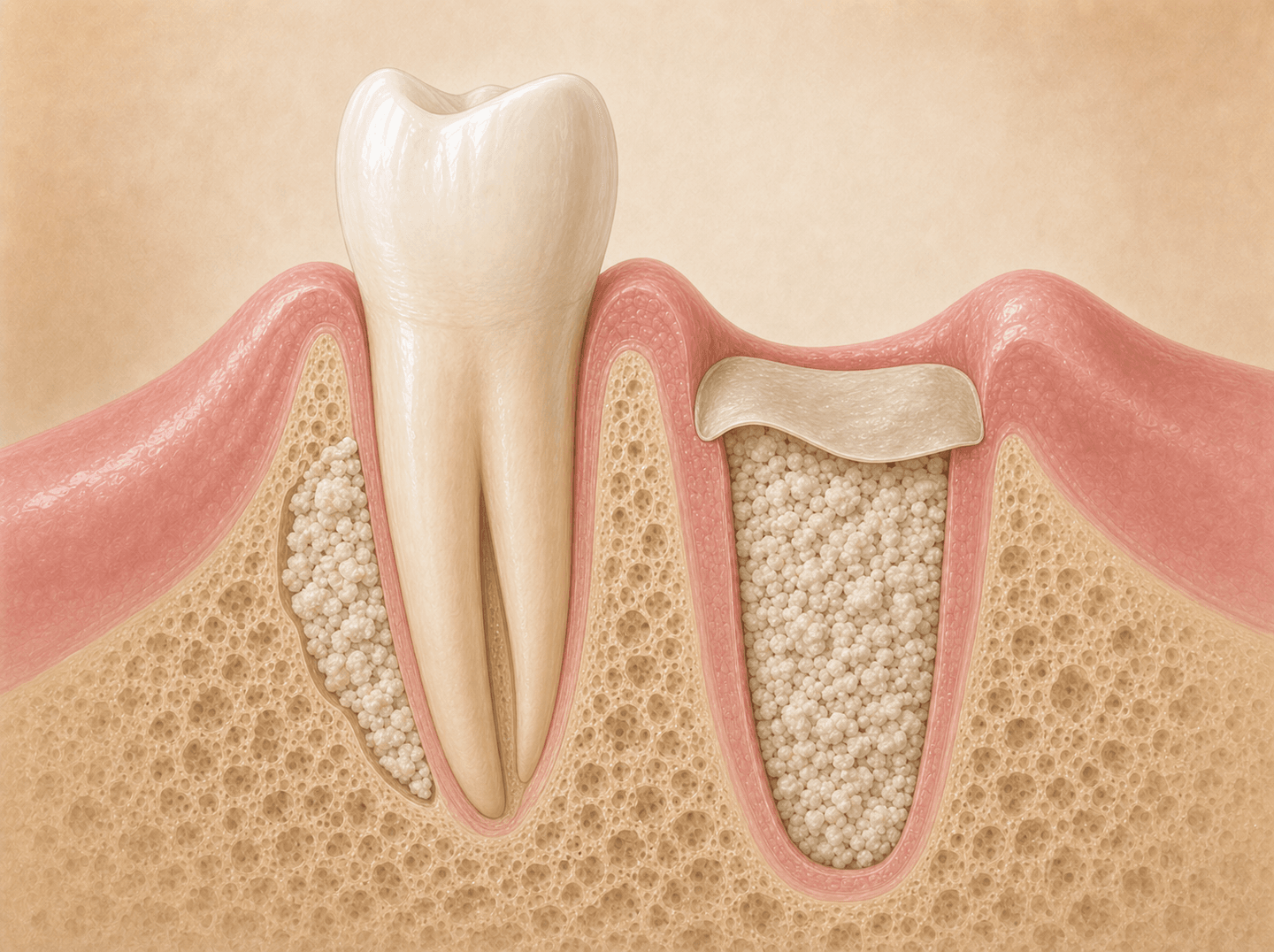
- Did a tooth or an implant come out of the site at this visit? A graft into that socket to hold the ridge for a later restoration is D7953, reported per site.
- None of the above? Building up a healed, established edentulous ridge as its own surgery is D7950, a by-report code. Rebuilding facial bones after trauma, tumor surgery, or a congenital defect, for reasons other than a prosthesis, is D7955.
The order settles the common overlaps. A tooth extracted and replaced with an immediate implant in one visit answers yes to question three before it reaches question four, so the graft around that implant is D6104 even though the socket is fresh. A crestal sinus lift done through the implant osteotomy answers yes to question one, so it keeps D7952 and does not fold into D6104.
The bone graft code family
The table lays out the site and timing for each code, plus what the code includes. Most coding errors come from the second and third columns.
| Code | Where the graft goes | When | Graft harvest included? |
|---|---|---|---|
| D4263 | Periodontal defect at a retained natural tooth, first site | Periodontal surgery | Descriptor is silent |
| D4264 | Each additional site in the same quadrant | Same surgery as D4263 | Descriptor is silent |
| D3428 / D3429 | Bone defect at the root tip of a retained tooth | With periradicular surgery | Includes donor or synthetic material |
| D7953 | Extraction or implant-removal socket, per site | Same visit as the extraction or removal | No, harvest is separate |
| D6104 | Implant site | Same visit as the implant placement | Descriptor is silent |
| D6103 | Bony defect around an existing implant | After the implant is already in place | Descriptor is silent |
| D7950 | Established edentulous ridge, height or width | Its own surgery, usually before an implant | Yes |
| D7951 | Sinus floor, lateral window approach | Before or with an implant | Yes |
| D7952 | Sinus floor, crestal approach | Often with the implant | Yes |
| D7955 | Facial bone defect from trauma, surgery, or a congenital cause | Reconstruction for reasons other than a prosthesis | No |
Three details in the table cause real denials.
D4263 and D4264 count defects, and the count resets at each quadrant. Two neighboring teeth with separate defects are two sites. One defect running through the bone between them is one site. The D4264 page walks through the counting rule. Both descriptors also rule out an edentulous space or an extraction site, and carriers enforce that from the tooth chart. A graft billed on the periodontal code at a tooth number the carrier shows as missing will usually deny.
One exception catches oral surgeons. AAOMS directs D4263 for a graft placed in the socket of an extracted impacted third molar when the purpose is regenerating bone on the distal of the second molar next to it. That graft treats the tooth that is staying, so it is a periodontal graft.
D6104 has no unit in its nomenclature. AAOMS’s bone graft coding paper calls it per site, and PEHP’s 2026 code guide allows it once per implant site at the time of placement. Document each grafted implant site separately and the unit question never comes up.
Membranes and biologics go on their own lines
Most graft descriptors put the barrier membrane outside the graft and send it to its own line. D7952’s descriptor does not mention a membrane either way. D4263, D4264, D6103, and D6104 also name biologic materials as separate. So a single grafted site can carry three lines: the graft, the membrane, and the biologic.
The membrane code follows the site. Since the 2023 rebuild of guided tissue regeneration, each site type has its own pair:
| Site where the membrane goes | Resorbable | Non-resorbable | Unit |
|---|---|---|---|
| Natural tooth | D4266 | D4267 | Per site |
| Implant | D6106 | D6107 | Per implant |
| Edentulous site: fresh socket, healed ridge, or sinus | D7956 | D7957 | Per site |
A membrane over a socket graft goes on D7956 or D7957. Several published billing guides still send socket membranes to D4266 and D4267, which are the natural-tooth pair. The descriptor for the edentulous pair names ridge augmentation, sinus lifts, and extraction sites as the places it applies. When a non-resorbable membrane comes out at a later visit, that removal is its own procedure, D4286.
Biologic materials go on D4265, per site. AAOMS says D4265 may be added when a biologic such as an enamel matrix derivative or a growth factor is mixed with the graft. Blood concentrates made from the patient’s own blood, such as PRF and PRP, are the unsettled case. AAOMS reports them on D7921, collection and application of an autologous blood concentrate, alongside the graft code. Carriers do not all agree, and the D4265 page covers the split.
Harvesting the patient’s own bone
Bone taken from the patient’s own body is an autogenous graft. Whether that harvest gets its own line depends on the graft code.
D7295 reports harvesting bone for an autogenous graft, and only in addition to graft codes that do not include getting the material. The ADA’s 2026 guide to graft material collection sorts the family this way:
- The harvest is excluded, so D7295 can be added. D7953 states it does not include obtaining the graft material. D7955 says the same.
- The harvest is included, so D7295 would double-report it. D7950, D7951, and D7952 each include obtaining the graft material.
- The descriptor does not say. D4263, D4264, D6103, and D6104 are silent. Check the plan before adding D7295 to any of them.
There is no CDT code for opening a container of donor or synthetic bone. The ADA’s guide says product choice belongs in the written narrative, so name the material type (autograft, allograft, xenograft, or alloplast) and the product in the note. Some plans do not pay D7295 at all. PEHP’s 2026 guide lists it as not covered.
Worked scenarios
Extraction with a socket graft, implant later. Tooth #30 comes out surgically. The socket is grafted with particulate allograft and covered with a collagen membrane, and the implant is planned for four months out. Code the extraction, D7953 for the socket, and D7956 for the resorbable membrane. Four months later, D6010 reports the implant. Add D6104 at that visit only if the surgeon grafts again around the fixture.
Extraction with an immediate implant. Tooth #8 comes out and an implant goes into the socket in the same visit, with graft packed into the gap between the fixture and the socket walls. The graft is D6104. The extraction and D6010 go on the same claim, and a membrane around the implant is D6106 or D6107. D7953 does not fit here, because the implant went in that day.
Periodontal surgery that also removes a tooth. A lower left quadrant surgery grafts vertical defects on the mesial of #19 and the distal of #21 and removes hopeless #20. The two grafts around the teeth that are staying are D4263 and D4264. The graft in the #20 socket is D7953. Code each graft against the tooth it sits beside.
Upper molar site with too little bone under the sinus. With only a few millimeters of bone left under the sinus, the surgeon opens a lateral window, lifts the sinus lining, and grafts, then places the implant months later. That is D7951 now and D6010 later. When enough bone remains to lift the floor through the osteotomy and seat the implant in the same visit, the lift is D7952 and the implant is D6010, each on its own line.
Replacing a failed implant. AAOMS works a case like this. The failing implant at #30 is removed, the site is grafted, and a resorbable membrane covers it. After healing, a surgical guide is made and a new implant is placed. The removal visit carries D6100, D7953 for the socket, and D7956 for the membrane. The later visit carries D6190 for the guide and D6010. When the implant comes out without removing bone or raising a flap, the removal code is D6105 instead of D6100.
Healed ridge too thin for an implant. A lower premolar site lost its tooth years ago and healed into a knife edge. The surgeon takes a block of bone from the ramus, fixes it to the ridge, and covers it with a non-resorbable membrane. That is D7950 with a by-report narrative, plus D7957. D7295 does not go on this claim, because D7950 already includes obtaining the graft. When the membrane comes out, that visit carries D4286.
Coverage and denial patterns
These hold across the whole family. The code pages cover the ones specific to each code.
An implant exclusion usually takes the graft down with it. Carriers tie most of these grafts to the implant they are preparing for. Cigna’s 2026 DPPO guidelines allow D7953 and D6104 only on plans that cover implant placement, and only when the planned implant meets the plan’s own coverage guidelines. A plan that excludes implants will often deny the socket graft too. Verify both benefits together.
Some plans require the medical claim first. Cigna’s DPPO guidelines make D7950, D7951, and D7952 allowable only with documentation that the medical plan denied the service. Submitting those codes straight to the dental plan gets a denial that no narrative will fix. When a plan works this way, the medical denial letter is part of the dental claim.
The site family has to match the chart. Carrier systems track which teeth are on file as missing. A periodontal graft code at an extraction site, a socket graft code on a healed ridge, or an implant-site graft with no implant on the claim is easy for a carrier to catch.
Necessity follows the planned restoration. UnitedHealthcare’s bone replacement graft policy, effective May 2026, supports ridge preservation after an extraction when a planned prosthesis would suffer from lost ridge volume, or to prepare the site for an implant. For grafts around retained teeth, it names infrabony and intrabony vertical defects and Class II furcations, and excludes teeth with a hopeless prognosis. A chart note that names the restoration the site is being built for answers most necessity reviews.
Frequency limits are per site and often per lifetime. PEHP’s 2026 guide is a clear example. It allows D7953 once per extraction site per lifetime and only at permanent teeth #2 to 15 and #18 to 31, with third molars excluded. D7950 is once per arch per lifetime, D7951 twice per side per lifetime, and D7952 once per implant site on upper posterior teeth. Other plans set their own limits, so check the specific plan.
A bundled line and a non-covered line behave differently. A bundling adjustment under a participating agreement is a write-off. A non-covered benefit may be billable to the patient if the agreement allows it and the patient signed a financial agreement before surgery. The EOB adjustment codes tell you which one you got.
Documentation that supports a graft claim
Five facts in the record carry almost every graft claim in this family.
- The site and what happened there that day. Tooth number for each graft, and whether a tooth came out, an implant went in, or an implant was already present. That one line settles the code.
- The defect or the reason for the graft. A vertical defect with its walls and depth for a periodontal graft, a dehiscence with exposed threads for an implant graft, residual bone height under the sinus for a sinus lift, and ridge width for an augmentation.
- The planned restoration. Implant, fixed bridge, or denture, with a rough timeline. This is what necessity reviews on D7953 and D7950 look for.
- The materials. Graft type and product, membrane type and whether it is resorbable, any biologic, and the donor site if bone was harvested.
- Images. A pre-op radiograph or cone beam image showing the defect or deficiency, attached to the claim.
D7950 is a by-report code, so its narrative is required on every claim. The dental narratives guide covers how to write one that a reviewer can approve without asking for more.
Billing a bone graft to medical
Medical crossover on bone grafts is narrow, and AAOMS has published a direct warning about it.
The two CPT codes most used for grafting are 21210, a bone graft to the nasal, maxillary, or malar area, and 21215, a bone graft to the mandible. Both include harvesting the graft. When the surgeon did not harvest bone, because the material was donor or synthetic, AAOMS says to append modifier 52 for a reduced service. The material itself may be reportable with CPT 99070 and an invoice, though some payers treat it as part of the global fee. Separate harvest codes 20900 and 20902 do not go with 21210 or 21215, because those codes already include the harvest.
AAOMS reports that Medicare contractors have found medical claims for bone grafts tied to implants and extractions, services Medicare excludes by statute, where the records showed synthetic material had been used. It calls crosswalking D7953 or D7950 to 21210 or 21215 inappropriate in most cases. Those CPT codes describe extensive reconstruction, often with bone taken from the hip, and they carry high relative values. For a minor reconstruction, AAOMS says the CDT code itself is the better choice for both dental and medical carriers. It calls 21210 and 21215 a closer fit for D7955, reconstruction after trauma or congenital defects. It allows that D7951 may crosswalk to 21210 for an extensive lateral sinus lift, and says D7952 does not.
When a plan requires a medical denial before the dental plan will consider the graft, as Cigna does for ridge augmentation and sinus lifts, send the medical claim first even if you expect it to deny. Attach the denial to the dental claim. For which plan pays first when a patient has both, see when medical is actually primary.
Verify any code against a current source before it goes on a claim. The CDT code reference covers the rest of the codebook, the dental implant codes guide covers the placement and restoration codes these grafts prepare for, and our insurance billing service is where this work lives day to day.
Common questions
- What is the dental code for a bone graft?
- There are several, and the site decides which one applies. A graft in a socket at the visit the tooth or implant comes out is D7953. A graft placed at the same visit as a new implant is D6104. A graft repairing a defect around an implant that is already in place is D6103. A periodontal graft around a tooth that is staying is D4263 for the first site in the quadrant and D4264 for each additional site. Building up a healed ridge as its own surgery is D7950. A sinus lift is D7951 through a side window or D7952 through the crest of the ridge.
- What is the code for a bone graft after an extraction?
- D7953, reported per site, when the graft goes into the socket at the same visit the tooth comes out. The same code covers a socket left by removing a failed implant. A membrane over that socket is reported separately, on D7956 if it is resorbable or D7957 if it is not, because a fresh socket counts as an edentulous site for the membrane codes. If a new implant goes into the socket at that same visit, the graft moves to D6104.
- Can D7953 and D6104 be billed on the same claim?
- Yes, when they describe different sites. A socket grafted at #19 with the implant deferred is D7953, and a graft around a new implant at #30 during the same appointment is D6104. At one site on one visit, only one of them fits. If the implant went in that day, the graft is D6104, even when the tooth came out minutes earlier.
- Which membrane code goes with a bone graft?
- The membrane code follows the site, and each site type has its own pair. At a natural tooth the codes are D4266 (resorbable) and D4267 (non-resorbable). Around an implant they are D6106 and D6107, reported per implant. At an edentulous site, which includes a fresh extraction socket, a healed ridge, and a sinus lift, they are D7956 and D7957. Taking out a non-resorbable membrane later is D4286.
- Is there a CPT code for a dental bone graft?
- CPT 21210 covers a bone graft to the maxillary, nasal, or malar area and 21215 covers the mandible, and both include harvesting the graft. The American Association of Oral and Maxillofacial Surgeons warns that crosswalking a socket preservation or ridge augmentation graft to those codes is generally inappropriate, because they describe extensive reconstruction, usually with bone harvested from the hip. When a surgeon uses donor or synthetic material instead of harvesting, AAOMS says to append modifier 52. The medical path fits trauma, pathology, and congenital reconstruction far better than an implant site.
- Do I bill D7295 every time the graft is the patient's own bone?
- No. D7295 reports harvesting the patient's own bone only when the graft code does not already include getting the material. D7953 says in its descriptor that it does not include obtaining the graft, so D7295 can go with it. D7950, D7951, and D7952 each include obtaining the graft material, so adding D7295 to them reports the harvest twice. There is no CDT code for opening a jar of donor or synthetic bone.
Working with us
Graft claims get paid when every line matches the surgery.
We verify the implant and graft benefits before surgery, code each graft, membrane, and biologic to the site it went into, send the medical claim first when the plan requires it, and work the appeal when a graft denies.