On this page
- Three questions for every unit
- Pontic and retainer crown codes by material
- Four bridges, line by line
- Retainer crown or single crown
- Implant-supported bridges
- Replacing an existing bridge
- The missing tooth clause
- Alternate benefits and material downgrades
- Recementing, repairing, sectioning, and removing
- Documentation for a bridge claim
- Common questions
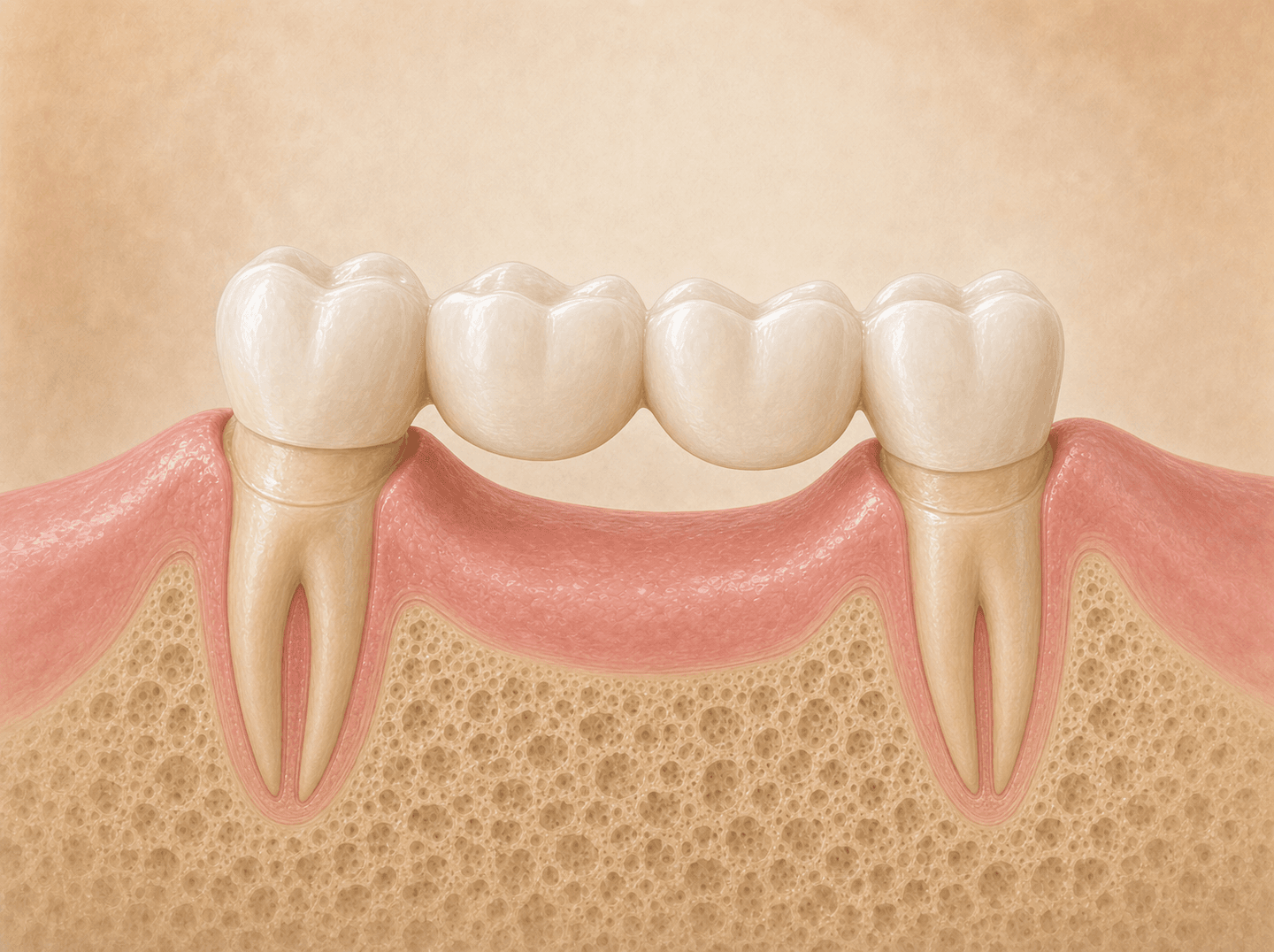
There is no single bridge dental code. The CDT codebook calls a bridge a fixed partial denture, and it reports one as a set of units: a pontic for each missing tooth in the span, and a retainer for each tooth or implant that holds the span up. Every unit is its own claim line with its own tooth number and fee. This guide covers how to pick the code for each line, the material table that most of the choices come from, and the coverage rules that apply to every bridge whatever it is made of.
Three questions for every unit
Take the bridge one unit at a time and answer three questions about each.
Is this unit a pontic or a retainer? A pontic replaces a missing tooth and sits on the gum. A retainer is attached to an abutment and carries the pontic. A three-unit bridge that replaces one tooth has two retainers and one pontic. Delta Dental of North Carolina’s 2026 dentist handbook puts it plainly: each abutment and each pontic is a unit.
How is the retainer attached, and to what? Most retainers are crowns on prepared natural teeth, coded D6710 through D6794. A resin-bonded bridge, often called a Maryland bridge, uses bonded wings instead of crowns, coded D6545, D6548, or D6549. Inlay and onlay retainers have their own series, D6600 through D6634. When the anchor is an implant or implant abutment, the retainer belongs to the implant family instead of this one.
What material did the lab use? Pontics and retainer crowns are both split by material, and the metal splits follow the noble-content classes the crown codes use. The lab prescription or invoice is the source for this answer. Two restorations can look the same in the mouth and still carry different codes.
Answer those three and each line has one code. Pontic codes do not depend on the retainers, so the same D6245 pontic sits between crown retainers, bonded wings, or implant retainers.
Pontic and retainer crown codes by material
These are the full-coverage pairs. Each row is one material, with the pontic code and the retainer crown code that go with it. All of them are current in CDT 2026, and the 2026 update revised or deleted none of them.
| Material | Pontic | Retainer crown |
|---|---|---|
| Porcelain or ceramic, no metal | D6245 | D6740 |
| Porcelain fused to high noble metal | D6240 | D6750 |
| Porcelain fused to predominantly base | D6241 | D6751 |
| Porcelain fused to noble metal | D6242 | D6752 |
| Porcelain fused to titanium | D6243 | D6753 |
| Full cast high noble metal | D6210 | D6790 |
| Full cast predominantly base metal | D6211 | D6791 |
| Full cast noble metal | D6212 | D6792 |
| Titanium | D6214 | D6794 |
| Indirect resin-based composite | D6205 | D6710 |
| Resin with high noble metal | D6250 | D6720 |
| Resin with predominantly base metal | D6251 | D6721 |
| Resin with noble metal | D6252 | D6722 |
A few retainers sit outside the table:
- Three-quarter crown retainers are D6780 (cast high noble), D6781 (cast predominantly base), D6782 (cast noble), D6783 (porcelain or ceramic), and D6784 (titanium). These are partial-coverage retainers. The full-cast retainers are D6790 through D6792, and mixing the two series up is an old error on bridge claims.
- Resin-bonded wings are D6545 (cast metal), D6548 (porcelain or ceramic), and D6549 (resin), reported once per wing.
- Inlay and onlay retainers run from D6600 to D6634, split by material and by two surfaces versus three or more.
- Interim units are D6253 for a pontic and D6793 for a retainer crown. They cover a provisional bridge worn while further treatment or diagnosis is finished before the final impression. The routine temporary worn while the lab makes the bridge is included in the bridge fee and has no line of its own. Delta Dental of North Carolina treats interim units reported within six months of the permanent bridge as part of the bridge fee, and PEHP’s 2026 guide pays an interim pontic once when it stays in place for at least six months.
Match the material across the span where the lab did. A claim with ceramic retainers and a porcelain-fused-to-metal pontic is either a genuinely mixed bridge or a code picked by habit, and a reviewer can’t tell which from the claim. If the bridge really is mixed, code each unit to what it is and let the lab slip back it up.
Four bridges, line by line
Three-unit ceramic bridge replacing #19. Zirconia retainers on #18 and #20 with a zirconia pontic at #19. The claim is D6740 on #18, D6245 on #19, and D6740 on #20, three lines on the cementation date. On a plan with a molar alternate benefit, #18 and #19 may be allowed at the metal equivalent, which is covered below.
Four-unit anterior bridge replacing #8 and #9. Ceramic retainers on #7 and #10 and two ceramic pontics. The claim is D6740 on #7, D6245 on #8, D6245 on #9, and D6740 on #10. Each pontic replaces one missing tooth, and plans pay for the number of pontics the space needs. Delta Dental of North Carolina’s handbook says benefits are based on that number and do not go past the normal complement of teeth.
Resin-bonded bridge replacing #7. A ceramic pontic at #7 with bonded ceramic wings on #6 and #8. The claim is D6548 on #6, D6245 on #7, and D6548 on #8. Each wing is a retainer and gets its own line, and the wing material matches the pontic.
Cantilever bridge replacing #7 from #6. One ceramic retainer on #6 carrying a ceramic pontic at #7, with nothing on the other side. The claim is D6740 on #6 and D6245 on #7. Some plans cap cantilevers at one pontic. Hawaii Dental Service’s 2023 procedure code guidelines deny any pontic beyond the first on a cantilever.
Retainer crown or single crown
The most expensive coding error on a bridge is billing an abutment crown as a single crown. The pairs are easy to confuse because they describe the same restoration. D2740 and D6740 are both all-ceramic crowns. D2750 and D6750 are both porcelain fused to high noble metal. What differs is the job. A D27xx crown restores one tooth and connects to nothing. A D67xx retainer is joined to a pontic and carries it.
The test is whether a pontic is in the prosthesis. If the crown is joined to a pontic, bill the retainer code. A claim that lists two single crowns and a pontic describes a bridge with no retainers. That draws a records request at best. At worst it reads as an attempt to get the abutments past the plan’s bridge rules or its missing tooth clause, which the ADA’s Code of Ethics treats as misrepresenting the procedure.
The error usually starts in the treatment plan. The case gets entered as a crown on one tooth, then becomes a bridge after the consult, and nobody changes the code on the abutments. Check the procedure codes against the lab slip before the claim goes out.
A related problem shows up when an abutment already has a crown. If a tooth was crowned recently and now has to be re-prepared as a retainer, the plan may deny that unit because the old crown is still inside its replacement window. Hawaii Dental Service’s guidelines do exactly that, denying any unit whose tooth still has a prior indirect restoration inside the time limit. Look at the crown history on each abutment before you quote the patient.
Implant-supported bridges
When the anchors are implants, the retainers leave this family. Implant bridges use their own retainer codes, split by whether the retainer sits on a separate abutment or attaches directly to the implant, and then by material. The abutment-supported all-ceramic retainer, D6068, is the implant counterpart of D6740. The pontics in an implant bridge still use the D62xx pontic codes from the table above.
That split is where tooth-supported and implant-supported claims get crossed. A natural-tooth retainer code on an implant case denies, and so does the reverse. The implant retainer family, the abutment codes, and the support question are covered in our guide to dental implant codes.
Replacing an existing bridge
Most plans limit how often they will pay for a bridge in the same place. The window is set by the contract and commonly runs five to seven years. PEHP’s 2026 guide limits benefits to one fixed partial denture per arch in a five-year period, counting tooth-supported and implant-supported bridges together. Hawaii Dental Service treats replacement as a possible benefit once the old bridge is more than five years old, when it has failed at the margins, has recurrent decay, or the tooth under it has fractured. Cigna’s Colorado individual dental policy waits 84 months from the insertion of the existing bridge. Delta Dental of North Carolina’s handbook leaves the window to the group contract.
Two things decide whether a replacement claim pays.
- The date the old bridge was seated. The window counts from the original seat, and the carrier reads its own history. A bridge placed at another office under the same carrier still counts. Ask the patient, check the carrier’s history during verification, and report it on the claim: the ADA claim form asks whether the service replaces a prosthesis and, if so, the date of the prior placement.
- Evidence that the old bridge failed. Hawaii Dental Service asks for a narrative stating the clinical reason for replacement whenever the x-rays and attachments don’t show decay, fracture, or a compromised tooth. An old bridge that is merely old is a weak claim. Recurrent decay under a retainer, a fractured abutment, or an open margin visible on the film is a strong one.
The missing tooth clause works differently on replacements than on first bridges. PEHP’s guide, for one, says the exclusion does not apply when a bridge, denture, or implant was already in place when coverage began. That exception is plan language, so check the contract instead of assuming it.
The missing tooth clause
The missing tooth clause excludes replacing a tooth that was already missing when the patient’s coverage started. The pontic is the unit that replaces that tooth, so the clause always reaches the pontic. What happens to the retainers depends on how the plan words the clause, and published plans go three different ways.
- The whole bridge is excluded. Cigna’s Colorado individual dental policy excludes the initial placement of a fixed bridge unless it replaces a natural tooth extracted while the person was covered. Under that wording the retainers go with the pontic.
- Only qualifying pontics pay. The same Cigna policy says that when one bridge replaces some teeth lost before coverage and some lost after, benefits are paid only for the pontics replacing teeth extracted during coverage.
- The abutments are reviewed on their own. PEHP’s 2026 guide says teeth missing before coverage may be ineligible for a period, and that abutment teeth may still be reviewed for a prosthodontic benefit.
Verify which wording applies before the treatment plan is presented, and don’t assume the retainers will pay. The date the tooth was lost decides the clause, so that date belongs in the record from the first visit. PEHP’s guide requires the narrative on bridge codes to state the date of tooth loss or extraction, along with medical necessity and a summary of the radiographic findings. The plan wording, how to verify it, and how to explain a denial to the patient are in our guide to the missing tooth clause.
Alternate benefits and material downgrades
A plan can pay a bridge at a lower allowance than the one billed without denying it. Three versions come up often.
Material downgrades on back teeth. Hawaii Dental Service’s guidelines process porcelain, porcelain-fused-to-metal, and resin units on molars as the metal equivalent for most plans, and apply D6240 or D6210 as the alternate benefit for an all-ceramic D6245 pontic on review. A zirconia bridge on the lower molars billed as D6740 and D6245 can come back paid at a cast metal allowance on every unit.
A partial denture instead of a bridge. Plans that consider a removable partial adequate may pay the partial’s allowance. Delta Dental of North Carolina’s handbook does not pay a posterior bridge and a partial denture in the same arch within the frequency window, and limits the benefit to the partial. Hawaii Dental Service processes anterior bridges with more than four pontics, and posterior bridges with more than three, as a removable partial.
Units the plan won’t count. Extra abutments added for splinting or an unusual condition, and pontics beyond the normal number of teeth for the space, are commonly denied. Delta Dental of North Carolina denies benefits for porcelain and resin inlay bridges outright, and both it and Hawaii Dental Service exclude fixed bridges for patients under 16.
Recementing, repairing, sectioning, and removing
Four procedures after the seat have their own codes, and each has a coverage rule worth knowing.
- Recementing a loose bridge is D6930, billed once for the whole bridge, including when a resin-bonded bridge is rebonded. Delta Dental of North Carolina treats a recement by the same office within six months of the seat as part of the original fee, pays one recement after that, and denies further recements by the same office.
- Repairing a bridge whose material failed is D6980. Delta Dental of North Carolina caps the fee at half the fee for a new bridge.
- Cutting a bridge apart so part of it stays is D9120. The code applies when some of the bridge will stay in place and keep working, for example after a failing abutment is extracted. Delta Dental of North Carolina pays it only in that situation.
- Taking a bridge off to replace it has no code of its own. Delta Dental of North Carolina treats sectioning done while removing and replacing a bridge as part of the new bridge, and Hawaii Dental Service lists crown removal among the services included in the restoration fee. Bill the new units and don’t add a removal line.
Documentation for a bridge claim
The attachments are the same whatever the material. Most bridge claims that pend are missing one of these.
- Tooth numbers for every unit, with the pontic positions clear. The missing tooth clause keys to the pontic position.
- The date each replaced tooth was lost, or a note that it was congenitally missing or lost during coverage.
- A preoperative radiograph that shows the space and the abutment teeth. Hawaii Dental Service lists an x-ray as the submission requirement on its bridge codes.
- A narrative covering medical necessity, the date of tooth loss, and the radiographic findings. PEHP accepts one narrative for all the units submitted together.
- The cementation date as the date of service. Delta Dental of North Carolina reports bridges on the cementation date, whatever cement was used. Hawaii Dental Service also wants the prep date when the patient’s coverage ended between prep and seat.
- The lab prescription or invoice, which backs up the material on every line if the carrier asks.
- For a replacement, the seat date of the old bridge and the reason it failed.
Send the predetermination with every unit on it, so the carrier rules on the bridge as a whole. That is where the missing tooth clause, the replacement window, and any material downgrade show up, before a tooth is prepared. For where the tooth numbers, narrative, and prep date go on the form, see the ADA dental claim form guide. Bridges are part of the work our insurance verification service checks before treatment, and the CDT code library has pages for the individual units.
Common questions
- What is the dental code for a bridge?
- No single CDT code reports a whole bridge. The claim carries one line for every unit. Each replacement tooth in the span is a pontic, coded D6205 through D6252 by material. Each anchor tooth gets a retainer, usually a retainer crown coded D6710 through D6794 by material. A three-unit porcelain-fused-to-high-noble bridge, for example, is D6750 on each abutment and D6240 for the pontic, three lines with three tooth numbers.
- Is a bridge retainer crown the same code as a single crown?
- No. A crown that anchors a bridge uses a D67xx retainer code even when it is the same material and the same lab work as a single crown. D6740 and D2740 are both all-ceramic crowns, and D6750 and D2750 are both porcelain fused to high noble metal. The D67xx code says the crown carries a pontic. If a pontic is joined to the crown, bill the retainer code.
- What is the CDT code for a Maryland bridge?
- A resin-bonded bridge has its own retainer codes for the bonded wings: D6545 for cast metal, D6548 for porcelain or ceramic, and D6549 for resin. Report one retainer line per wing. The pontic uses the ordinary pontic code for its material, such as D6245 for an all-ceramic tooth. Coding educators recommend matching the wing material to the pontic material. When the bridge debonds and is rebonded, that is D6930.
- How often will dental insurance replace a bridge?
- The replacement window comes from the patient's contract, and five to seven years is common. PEHP's 2026 guide allows one fixed partial denture per arch in 5 years, Hawaii Dental Service's 2023 guidelines consider replacement once the old bridge is more than 5 years old, and Cigna's Colorado individual policy waits 84 months. Plans also want the old bridge to have actually failed. When the x-rays don't show decay, fracture, or another failure, send a narrative explaining why it needs replacing.
- Are implant bridges coded with the same codes?
- Only the pontics. When the anchors are implants or implant abutments, the retainers move to the implant family, starting with D6068 for an abutment-supported all-ceramic retainer. The pontics in the span still use the D62xx pontic codes. Our guide to dental implant codes covers the implant retainer choices.
- Is there a code for removing an old bridge?
- Not a separate one for a full removal. Taking off a bridge you are about to replace is treated as part of the new bridge. D9120 reports cutting a bridge apart when some of it will stay in the mouth and keep working, for example after an abutment is extracted. Delta Dental of North Carolina's 2026 handbook folds D9120 into the new bridge fee when the sectioning is part of removing and replacing the prosthesis.
Working with us
Bridge claims are won or lost before the prep appointment.
We verify the missing tooth clause, the replacement window, and the plan's material rules before the abutments are prepared, send the predetermination with every unit on it, and build the final claim line by line from the lab slip so the codes match what was seated.