On this page
- Tooth type sets the root canal code
- Root canal codes at a glance
- First root canal or retreatment
- When the root canal is started and not finished
- Pulpotomy and the codes for young teeth
- Procedures that ride along with a root canal
- When the tooth changes the plan
- The restoration after the root canal
- Surgical endodontics
- Documentation that holds across the family
- Common questions
Root canal coding comes down to two facts about the tooth: what kind of tooth it is, and whether it has had a root canal before. Those two settle the code for most root canals. The rest of the endodontic codes cover what happens when a root canal isn’t the whole story, such as an emergency visit before it, a tooth that can’t be finished, a young tooth that needs a different procedure, or surgery after it. This guide covers how to pick among them and the billing rules that hold across the family. Each code page has the detail for its own code.
Tooth type sets the root canal code
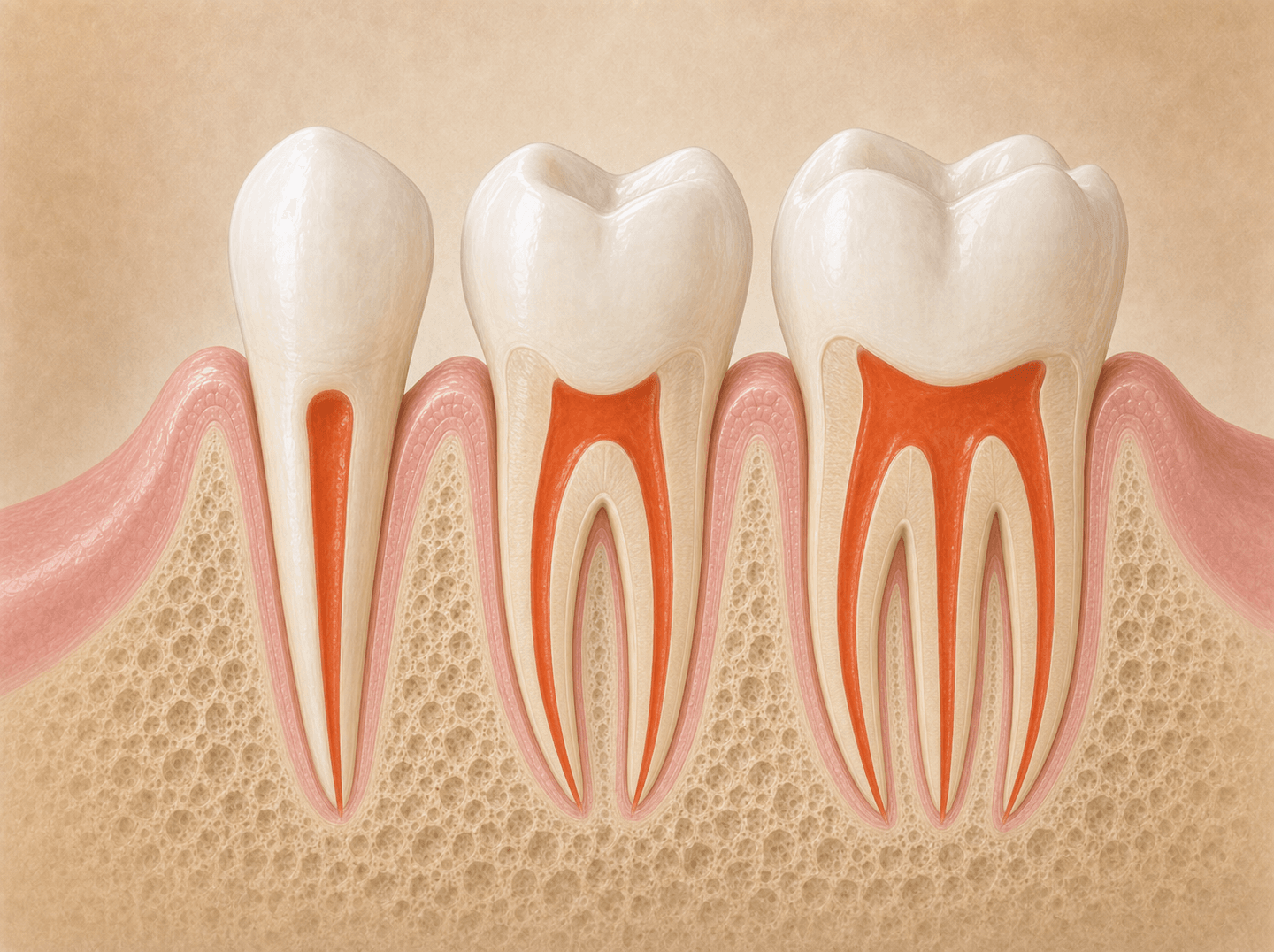
The first root canal on a permanent tooth is one of three codes, and the only thing that separates them is the kind of tooth.
- D3310 for an incisor or canine, teeth 6 through 11 and 22 through 27.
- D3320 for a premolar, teeth 4, 5, 12, 13, 20, 21, 28, and 29.
- D3330 for a molar, including third molars.
Canal count and difficulty don’t move the code. A lower incisor with two canals is still D3310, a premolar with three canals is still D3320, and a calcified molar that took three visits is still D3330. The fee schedules follow the same split, since carriers set allowances by tooth type. When the anatomy was genuinely unusual, record it in the chart and the narrative.
The same three codes also cover a primary tooth that has no permanent tooth coming in behind it, according to the AAE’s Endodontists’ Guide to CDT. A primary tooth with a successor gets a resorbable filling instead, D3230 for a primary incisor or canine and D3240 for a primary molar.
Coding and coverage split on third molars. D3330 is the correct code on a third molar, but some plans exclude third molars from the root canal benefit. PEHP’s 2026 guide is one. Verify before treating a wisdom tooth.
Root canal codes at a glance
| What was done | Code |
|---|---|
| First root canal, incisor or canine | D3310 |
| First root canal, premolar | D3320 |
| First root canal, molar | D3330 |
| Redo of a failed root canal, anterior, premolar, or molar | D3346, D3347, D3348 |
| Pulp removed to relieve acute pain, root canal finished later | D3221 |
| Pulp in the crown removed and medicated, root pulp kept alive | D3220 |
| Partial pulpotomy on a permanent tooth whose root is still forming | D3222 |
| Resorbable filling in a primary tooth with a successor | D3230 (anterior), D3240 (posterior) |
| Apex closure on an immature root, over several visits | D3351, D3352, D3353 |
| Pulpal regeneration | D3355, D3356, D3357 |
| Blocked canal opened without surgery | D3331 |
| Treatment stopped because the tooth is fractured or can’t be saved | D3332 |
| Perforation sealed from inside the tooth | D3333 |
| Root tip removed surgically | D3410, D3421, D3425, plus D3426 per additional root |
| Filling placed in the root end during surgery | D3430, per root |
| Sealing layer over the canal openings, restoration placed later | D3911 |
All of these are current in CDT 2026. The 2026 update added, revised, and deleted no endodontic codes.
The staged codes report one visit each. D3351 is the first apexification visit, D3352 is each visit where the medication is replaced, and D3353 is the final visit, which includes the completed root canal. Pulpal regeneration runs the same way from D3355 to D3357. Coverage for both is narrow. Delta Dental of North Carolina’s 2026 handbook pays apexification only on permanent teeth with incomplete root development or for a perforation repair, and treats pulpal regeneration as experimental. PEHP’s 2026 guide doesn’t cover regeneration either.
First root canal or retreatment
Once you know the tooth type, the pre-op radiograph answers the second question. Root canal filling material visible in the canals means the tooth was treated before, and the procedure is a retreatment: D3346, D3347, or D3348 by the same tooth-type split. Canals with nothing in them mean a first root canal.
The case that trips offices up is a tooth that was opened and medicated somewhere else but never filled. The patient says they already had a root canal. The film shows an access opening, a temporary, maybe medicament in the canal, and no fill. That tooth has no completed root canal to redo, so finishing it is a first root canal. The AAE’s coding scenario for a root canal started by another dentist codes the completion as D3320, the initial code, on a premolar that arrived with calcium hydroxide in the canal. The D3346 page works through the same case on a front tooth.
Two rules decide whether a retreatment pays.
The window after the original root canal. Delta Dental of North Carolina’s 2026 handbook treats a retreatment by the same office within 24 months as part of the original procedure, not billable to the patient, and denies one by a different office inside the same window. PEHP’s 2026 guide sets 12 months and allows retreatment once per tooth. Pull the completion date of the original root canal and find out who did it before the claim goes out.
Lifetime limits. Plans commonly pay initial therapy once per tooth. A retreatment billed on a first-root-canal code tends to deny as a duplicate, because the carrier already has a root canal on file for that tooth.
When the root canal is started and not finished
Three different situations get lumped together as an unfinished root canal, and each one codes differently.
The patient came in with acute pain. The dentist removed the pulp to relieve the pain and will finish the root canal at a later visit, or refers it out. That visit is D3221, pulpal debridement. The D3221 descriptor rules it out when the root canal is completed on the same day, so D3221 and D3310, D3320, or D3330 never go on the same tooth on the same date.
When the root canal is finished at a later visit, coding and payment go different ways. The AAE’s coding scenarios report D3221 at the first visit and the root canal at the completion visit, including when the same office does both. Payers are split on paying for it. Delta Dental of North Carolina’s 2026 handbook folds D3221 into the root canal only when the same office does both on the same date. PEHP’s 2026 guide goes further on a permanent tooth: it pays debridement only when a different provider completes the root canal, and expects that root canal within 12 months. Stabilize-and-refer is the case where D3221 most reliably pays on its own.
The tooth can’t be finished. The dentist spent real time diagnosing and treating the tooth, then found a fracture, a tooth that can’t be restored, or canals that can’t be treated. That is D3332, incomplete endodontic therapy. The AAE recommends sending it with a narrative and radiographs to reduce denials, and PEHP’s 2026 guide allows it twice per permanent tooth.
The patient never came back. Nothing about the tooth stopped the treatment. There is no completed root canal to bill, so the completed code can’t go on the claim. Report what was actually done, and send a report explaining that the patient didn’t return. Delta Dental of North Carolina’s handbook says it reviews incomplete therapy individually when a report shows the patient failed to complete treatment.
Pulpotomy and the codes for young teeth
D3220, therapeutic pulpotomy, removes the pulp in the crown and keeps the pulp in the roots alive. Its descriptor says it isn’t to be read as the first stage of a root canal. On a permanent tooth that is going on to a root canal, the pain-relief visit is D3221.
Carriers enforce that line. Delta Dental of North Carolina’s handbook processes a pulpotomy on a permanent tooth as palliative treatment and doesn’t pay it alongside a root canal. PEHP’s guide deducts a same-provider pulpotomy from the root canal fee.
The young-tooth codes follow the same logic. A partial pulpotomy on a permanent tooth whose root is still forming, done to keep the pulp alive so the root can finish developing, is D3222. If the pulp in that immature tooth has already died, the procedure is apexification or regeneration, from the staged codes in the table above.
Procedures that ride along with a root canal
Several codes describe work done during or around a root canal. Most are legitimate codes that carriers often treat as part of the root canal, so bill them only when the work was really a separate procedure.
- D3331, a blocked canal opened without surgery. It reports making a path through a canal blocked by a separated instrument, a broken post, or heavy calcification, in place of surgery. Delta Dental of North Carolina treats it as part of a same-day root canal by the same office. A 2016 AAE article reported that a number of plans routinely deny D3331 as overused, and advised reporting it only when clearing the obstruction was time-consuming and complicated, then appealing a denial with a radiograph or narrative.
- D2955, post removal. Getting a post out before a retreatment is often bundled into the retreatment. The same AAE article says plans see D2955 the same way as D3331, and that it belongs on a claim only when removing the post was time-consuming and complicated.
- D3333, perforation repair from inside the tooth. The descriptor covers a perforation caused by resorption or decay. It excludes a perforation the billing provider caused.
- D3911, intraorifice barrier. A sealing layer over the canal openings when the final restoration isn’t placed the same day. It isn’t a final restoration, and Delta Dental of North Carolina treats it as part of the root canal fee.
- Radiographs. The diagnostic films taken to evaluate the tooth bill on their own date. Working films and the final film are part of the root canal under both Delta Dental of North Carolina’s and PEHP’s policies. Send the final film as the claim attachment, but don’t expect it to pay as a separate image.
- D9110, palliative treatment. Pain relief that didn’t enter the pulp. Delta Dental of North Carolina doesn’t pay it by the same office alongside D3221 or on the same date as the root canal.
When the tooth changes the plan
The treatment plan is a prediction, and the tooth sometimes proves it wrong once it’s opened. The claim has to report the procedure that was actually done, even when that differs from what was predetermined. An approved predetermination for one code doesn’t carry over to a different one.
Common ways the code changes mid-treatment:
- Planned as a first root canal, the film shows an old fill. It’s a retreatment, and the retreatment window and history questions apply. This one should be caught on the pre-op film before the appointment.
- Planned as a retreatment, the canal was never filled. It’s a first root canal, as described above.
- Planned as a root canal, the tooth is fractured. Treatment stops and the code is D3332, sent with a narrative and films. If the tooth then comes out, the extraction is billed as its own procedure.
- Planned as a retreatment, the canal is blocked. The dentist may open it nonsurgically (D3331), switch to surgery (D3410 and its siblings), or both at separate visits.
- Planned as a pulpotomy on a young permanent tooth. If the root is still forming and the pulp is kept alive, the code is D3222. If the pulp turns out to be dead, it’s apexification.
- One root of a molar can’t be saved. Removing the root and leaving the crown intact is D3450, root amputation, per root. Cutting the tooth through the crown and root is D3920, hemisection, which excludes the root canal.
When the code changes, update the procedure in the practice management system before the claim is built, attach the films that show why, and write a one-line narrative stating the change. A claim that arrives as D3330 after a predetermination for D3348, with nothing explaining the difference, reads as an error and gets pended.
The restoration after the root canal
Every root canal and retreatment code excludes the final restoration, so the tooth’s restoration is billed separately on the date it is done. What that restoration is depends on how much tooth is left.
- A filling in the access opening. When the tooth is otherwise sound, a composite closes the access. The AAE’s scenarios report it as a one-surface composite, D2330 on a front tooth or D2391 on a back tooth.
- A buildup before a crown. D2950 reports building up the core when there isn’t enough tooth left to hold the crown. Delta Dental of North Carolina pays it only when it is needed to retain the crown, and not when it just fills an undercut in the prep.
- A post and core. D2952 is a cast post and core and D2954 is a prefabricated post with a core. Delta Dental of North Carolina pays both only on a tooth that has had a root canal, and denies a cast post and core when radiographs show more than half the crown’s structure remains. D3950, canal preparation for a preformed post, isn’t reported by the same practitioner alongside D2952, D2953, D2954, or D2957.
- The crown. D2740, D2750, or the crown code for the material, on the seat date.
Two interim codes get misused here. D2940, the interim direct restoration, is excluded from endodontic access closure by its own descriptor. D3911 is the code for a barrier over the canals when the permanent restoration comes later. Temporary fillings placed between endo visits are part of the root canal, and Delta Dental of North Carolina’s handbook says so in its general endodontic policy.
Surgical endodontics
Apicoectomy codes split by tooth type first, then by root count. D3410 covers an anterior tooth. D3421 is the first root of a premolar and D3425 the first root of a molar, with D3426 added for each additional root treated in the same surgery. None of them includes the root-end filling. That is D3430, reported per root, so a molar with two roots resected and filled is D3425, D3426, and D3430 twice.
Other surgical codes can go on the same claim: D3428 and D3429 for a bone graft with the surgery, D3431 for biologic materials, and D3432 for a resorbable membrane. PEHP’s 2026 guide allows an apicoectomy once per tooth in three years, and doesn’t pay surgical root exposure (D3501 to D3503) or resorption repair (D3471 to D3473) by the same dentist on the same date as the apicoectomy.
Carriers look for the reason surgery was chosen over retreatment. The narrative should say why a nonsurgical retreatment wasn’t done or failed, for example a well-sealed post the dentist chose not to remove, or a retreatment that didn’t resolve the lesion.
Documentation that holds across the family
Endodontic claims pend on attachments more than on codes. Five items cover most of what carriers ask for.
- A pre-op periapical that shows the pathology and, for a retreatment, the existing fill.
- A post-op periapical that shows the completed fill to the apex of every canal, labeled so the reviewer knows which film is which.
- The date the canals were filled as the date of service on the root canal line.
- For a retreatment, the date of the original root canal and who did it, with a narrative giving the diagnosis and why the first treatment failed. PEHP’s 2026 guide lists both as requirements on D3346 through D3348.
- A narrative and films on D3331, D3332, and the surgical codes. The AAE’s guide recommends both for D3331 and D3332 to reduce denials, and surgical claims need the reason retreatment wasn’t the answer.
Attach the films to the claim itself. Films stored only in the patient’s chart never reach the carrier. For where the narrative and attachments go on the form, see the ADA dental claim form guide. Endodontic claims are part of the daily work of our insurance billing service, and every code in this guide that has its own page is linked from the table above.
Common questions
- What is the CDT code for a root canal?
- It depends on the tooth and on whether it was treated before. A first root canal on a permanent tooth is D3310 for an incisor or canine, D3320 for a premolar, and D3330 for a molar. Redoing a failed root canal uses the matching retreatment code: D3346, D3347, or D3348. None of the six includes the filling, buildup, or crown that restores the tooth afterward. Those are billed separately on the dates they happen.
- Is D3320 a root canal?
- Yes. D3320 is a completed root canal on a permanent premolar, the tooth between the canine and the first molar. It covers the access, cleaning, shaping, and filling of the canals, and it applies whether the premolar has one canal or two. It does not cover the restoration afterward. If the premolar already had a root canal that failed, the redo is D3347.
- Can you bill pulpal debridement and the root canal on the same day?
- No. The D3221 descriptor itself says it isn't used when the root canal is completed on the same day. Debridement at an earlier emergency visit can be reported on that visit's date. Whether it pays separately is a plan question. Delta Dental of North Carolina's 2026 handbook folds it into a same-day root canal by the same office, and PEHP's 2026 guide pays it on a permanent tooth only when a different provider finishes the root canal.
- What code do you use when a root canal is started but can't be finished?
- It depends on why it stopped. If the tooth turned out to be fractured, unrestorable, or impossible to treat after real time was spent diagnosing and treating it, the code is D3332, sent with a narrative and radiographs. If the canals were debrided and the root canal will be finished at a later visit, the AAE's coding scenarios report that first visit as D3221. A completed root canal code never goes on a claim until the canals are filled.
- How soon after a root canal will insurance pay for a retreatment?
- Plans set a waiting window from the original root canal. Delta Dental of North Carolina's 2026 handbook uses 24 months: inside it, a retreatment by the same office is part of the original fee and one by a different office is denied. PEHP's 2026 guide uses 12 months. Check the completion date of the original root canal, who did it, and the patient's plan before the retreatment is scheduled.
- Is the crown included in the root canal code?
- No. Every root canal and retreatment code excludes the final restoration. The access filling, any buildup or post and core, and the crown are separate procedures billed on the dates they are done. A molar root canal followed by a crown is typically three claim lines on three dates: the root canal on the day the canals are filled, the buildup at the crown prep, and the crown on the seat date.
Working with us
Endo claims pend for missing films and missing dates. We send both the first time.
We check the tooth's endo history and the plan's retreatment window before the appointment, code by tooth and by treatment history, and attach the pre-op and post-op films and the narrative the claim needs. When a root canal denies, we work the appeal with the records that answer it.